ARTICLE BASED ON THE v1.6 PLAYTEST RULES – SEE THE UPDATED VERSION HERE
Hello folks! Forgive me if I haven’t been around in a while, I was forced to take a small break due to life and other stuff getting in the way, but now I’m back at the desk. In the meantime we’ve had some interesting Kickstarter updates from Factory Fortress Inc. and it looks like the official rulebook is just around the corner. Until that, however, playtest rules v1.6.3 is the most updated document we have so I’ll go on talking about the current ruleset, and I’ve already planned to revisit all the articles once the full rules are out. So, going on from where we left, today we talk about Keywords.
An important part of the game, Keywords condense and streamline the rulebook and the profiles of units and items by referencing to shared universal rules. That’s why in my opinion they deserve a section on their own in our analysis of the Trench Crusade rulebook. For my analysis I found it helpful to divide the keywords in 4 broad categories depending on how they interact with the various game elements. Thus we have keywords that only define which category a model belongs to, without referring to particular rules, keywords that serve as a reminder of general rules, and keywords that introduce additional, commonly shared, rules for items and models respectively, plus a few keywords that specifically apply only when making attacks.
Be warned, some of the keywords described below have rules that are not 100% tight. Some have been clarified, others not yet. I’ll try to give official interpretation when possible, and when not, I’ll provide my personal ones and the reason behind them. As always. let’s not forget that Trench Crusade is still a work-in-progress project and as such, things are susceptible to change.
Descriptive Keywords: These keywords don’t usually have any bespoke rules attached to them: they only serve to describe which categories or faction the model belongs to. BLACK GRAIL, HERETIC, PILGRIM, NEW ANTIOCH, SULTANATE and THE COURT define the model’s faction, while ARTIFICIAL, and ELITE have interactions with some in-game or warband building rules that explicitly refer to them but bring no intrinsic special rule.
Important note: the “Artificial Life” rule of the Artillery Witch and the “Artificial Body” rule of the Sultanate Takwin creatures only share the word “Artificial” with the keyword. It’s important to remind that the ARTIFICIAL keyword, by itself, is just a descriptor and in no way implies that the model possessing it has any of the aforementioned rules.
General Rules Keywords: Keywords such as ACTION, RISKY ACTION, +DICE and -DICE are used throughout the game to describe general actions a model can take and their eventual modifiers, if any. Similarly, BLOOD MARKER, BLESSING MARKER and INFECTION MARKER are common keywords that refer to core rules and game concepts associated to those markers.
We’ve already thoroughly described how ACTIONS and their modifiers work in a previous article, so we won’t delve much into them now. We’ll just remind that whenever an ability or effect during the game requires a model to generically “take an ACTION” without specifying a particular type of ACTION (e.g. “take a Ranged Attack ACTION”), then it means that the model has to roll on he Action Success Chart, with the effects of the ACTION in case of success or failure described in the text.
Item Keywords: these are keywords that describe or summarize the properties of certain items:
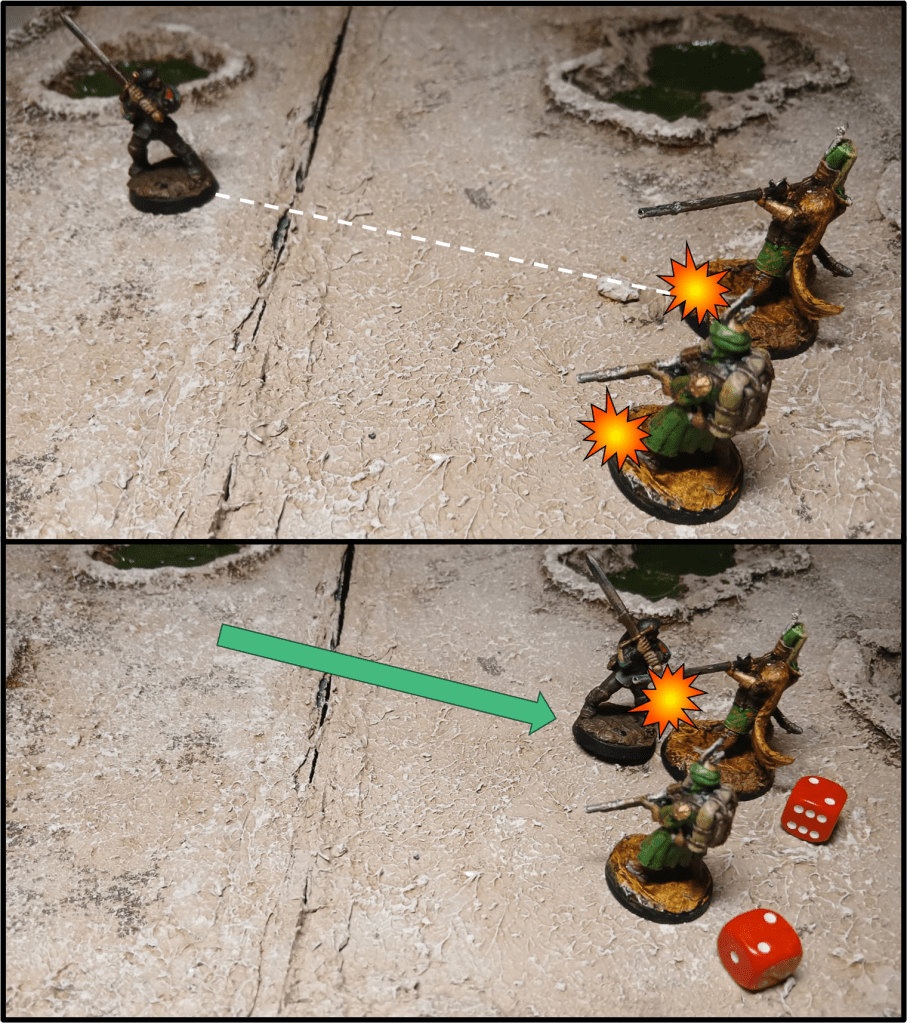
ASSAULT: Ranged attacks made with weapons that have this Keyword do not prevent a model from charging during the same activation. A charge may only be made if a single ranged attack is made with a weapon with this Keyword, regardless of any other rules that the weapon might have.
A model armed with a ranged weapons with the Keyword ASSAULT is allowed to make a single ranged attack ACTION with that weapon and Charge in the same activation. This is regardless of the order of those ACTIONS: the most common use is to make a ranged attack ACTION with the ASSAULT weapon before the Charge, but Charging, dispatching the enemy with a Melee Attack ACTION and then making a Ranged Attack ACTION is also possible.
CONSUMABLE: An item with this keyword can only be used once. After the battle, any items with this keyword that were used are lost.
CONSUMABLE items can be divided in two categories: those who have a one-and-done effect (e.g. the Satchel Charge: hit or miss, once you throw it it’s gone) and those who have effects that can be used at the beginning of the battle and last for the whole game, like for example Incendiary Ammunition. If you activate one of those effects during the pre-battle sequence, the item is considered expended, even if you don’t actually get to use its benefit during the battle.
CUMBERSOME: Model always requires two hands to use this weapon, even if the model has the Keyword STRONG. A weapon with the Keyword CUMBERSOME ignores this restriction when benefiting from the Shield Combo rule.
CUMBERSOME weapons always count as two-handed regardless of whether the model is STRONG or not, not allowing the model to use them together with an off-hand weapon. They can’t also be used with a shield (unless they also have the Shield Combo property). This keyword is mostly seen on defensive weapons like Polearms, Halberd-Gun or the Lochaber Axe, weapons that come in a pair such as Tartarus Claws, or weapons that would be unpractical to wield one-handed, for example the Prussian Tank-Splitter Sword or the trusty Bayonet.

House of Wisdom [To be confirmed]: Though yet unconfirmed, it is possible that the last line is a holdover from a previous version of the Shield Combo rules that caused the weapon to require 1 less hand when combined with a Shield, rather than the Shield requiring no hands. This means a STRONG model wielding a polearm, an off-hand weapon and a shield is likely not intended.
GRENADE: Grenade-type weapons ignore penalties for cover and long range. They do not count towards the number of ranged weapons a model can carry and do not have to be held in your hand at all times. A model armed with grenades can use them as many times as they wish.
GRENADES are short-range ranged weapons that don’t count towards the maximum number of weapons the model can be equipped with. As we’ll see in a future article about warband building, a model can be equipped with only one weapon with the GRENADE keyword, but if so, it has a supply of grenades that last for the whole battle (with the notable except of the Satchel Charge, it’s LIMITED keyword and “one per model” restriction in the New Antioch Armoury take precedence). As Grenades count as ranged weapons, and using them requires a Ranged Attack ACTION, a model can’t throw a GRENADE and attack with another Ranged Weapon in the same activation unless it has a special rule that allows it to.
Please note that the Rocket-Propelled Grenade (which some warbands can purchase as a Glory Item) does not count as a GRENADE, as it lacks the respective keyword: save for a very limited number of exceptions, item names are not enough to qualify an item as belonging to a certain category.
HEAVY: If carrying a weapon, armour or equipment with this Keyword, the model cannot move/dash and shoot during its Activation, and the model cannot roll D6 and add it to the Charge move. A model can only carry one item with this Keyword.
A non-STRONG model carrying an HEAVY item always suffers both penalties, regardless of the nature of the item. Thus a model carrying a HEAVY melee weapon wouldn’t also be able to move or dash (in any capacity: no retreat or charge as well) and make a ranged attack action with a non-HEAVY ranged weapon in the same activation, and vice versa, a non-STRONG model carrying a HEAVY ranged weapon would only use its base Movement value during a charge.
LIMIT (X): You can only purchase as many of this piece of equipment/weapon/armour as indicated by the number in parenthesis for your warband. If you find more via looting/exploration, you can break this limit.
As we’ll see when we’ll talk about warband building, it’s important to remember that the LIMIT on certain items refers to the warband as a whole, not just to the models that are fielded in battle.
A few items “count as” a different item (usually adding bespoke rules on top of that). For example, The New Antioch’s Glory Item Ducal Winged Armour “counts as a Machine Armour” adding increased movement speed and the ability to fly on top of the standard Machine Armour’s rules. I have to admit it is currently unclear whether “counts as” only applies to the item’s rules (e.g., has the same rules but it is treated as a separate item) or also to its LIMIT. I personally lean towards the first hypothesis, but that’s my point of view. If there’s any official clarification I’ll let you know.
Attack Keywords: a subset of items keywords, these describe the properties of an attack made by a weapon, item or ability, generally influencing the injury roll caused by the attack in particular ways.
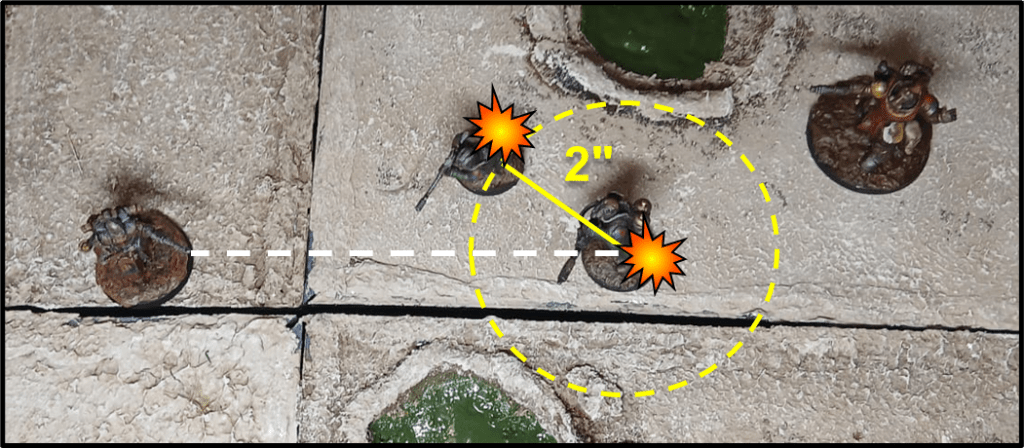
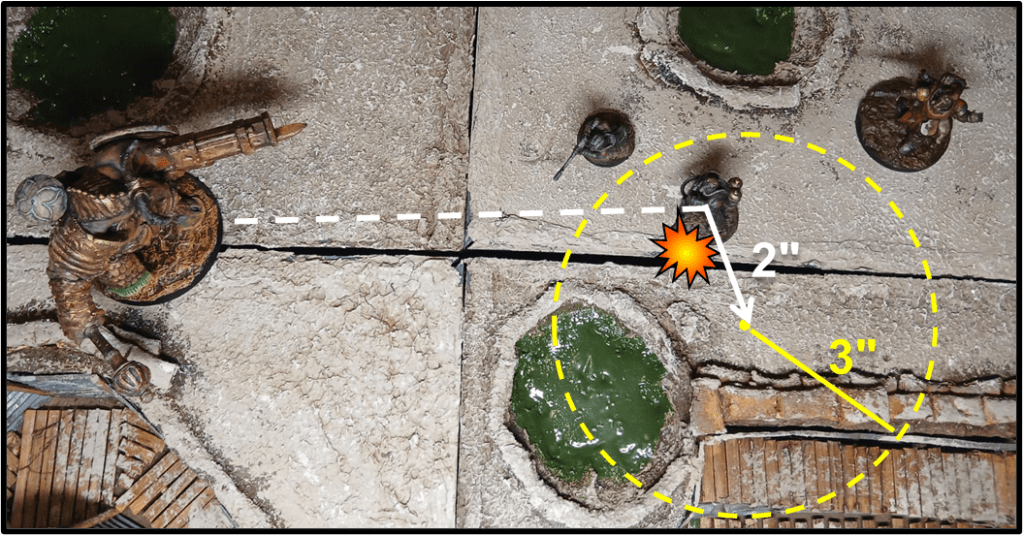
BLAST(X): A weapon with BLAST (X) has an area of effect with a radius of inches indicated by X. If this weapon targets a model, this radius is measured from the centre of that model’s base in all directions. If this weapon targets a point on the ground, this radius is measured from that point in all directions, including vertically. If the Attack ACTION with this weapon is successful, it hits every model within this radius that the target (either model or point) has line of sight to (i.e. not completely blocked by terrain).
When using a BLAST weapon, choose a target and roll to hit as normal. If you hit, all models, friend or foe, within X” of the center of the BLAST (i.e. the center of the target’s base on attacks that target a model), are hit and suffer an injury roll. As the distance from the centre of the BLAST is also measured vertically, the BLAST itself has the shape of a hemisphere originating in its centre (instead of an infinitely tall cylinder, which you would have if you only considered the horizontal distance from the centre). A model that cannot be seen from the center of the BLAST, for example because it’s behind a wall, is not hit by this attack. Roll separately on the Injury Chart for each model hit. On a Critical Hit, the additional +DICE to the injury roll apply to all models hit by the attack.
As per normal ranged attack rules, if an attack with BLAST(X) misses, it will have no effect whatsoever. The grenade or shell is a dud, or it lands off-target without doing any real harm.
Note that some BLAST weapons will allow you to target a point on the ground and on a miss, the attack will scatter in a direction chosen by the opponent. That’s a rule specific to those weapons, such as the Infernal Bomb, the MURAD bombard or Burning Inferno: unless differently specified, BLAST weapons such as Grenades must target a model.
CRITICAL: When attacking with a weapon with this keyword, add +2 DICE (instead of 1) to any injury rolls the weapon causes if you roll a Critical (i.e. 12+) on the Action Success Chart.
Remember that all weapons add +1 DICE to the injury roll on a critical success. The keyword CRITICAL increases this injury modifier to +2 DICE.
FIRE / GAS / SHRAPNEL: A model hit by a weapon with this Keyword suffers a BLOOD MARKER, in addition to any other effects of the attack. The model suffers this BLOOD MARKER even if the attack has no other effects or is otherwise negated. Some equipment or abilities can negate the additional BLOOD MARKER caused by this Keyword.
Weapons with the keyword FIRE, GAS or SHRAPNEL work in a similar way, adding a BLOOD MARKER to any other injury the weapon causes (including a “no effect” roll on the Injury table). This additional BLOOD MARKER is assigned after the injury roll is made, so it cannot be spent immediately to affect the outcome of the roll.
There is no mechanical difference between the three, but different abilities and equipment interact differently with them, most often negating the additional BLOOD MARKER inflicted by one of these keywords (for example a Combat Helmet will negate the BLOOD MARKER caused by SHRAPNEL but won’t have any effect against FIRE or GAS) or applying a modifier to an injury roll caused by that keyword.
While an attack can only have one instance of each keyword (there is no benefit to applying the FIRE keyword to a FIRE attack. It either has the keyword or it doesn’t), different keywords can apply to the same attack and each is cumulative, so for example an attack with FIRE and GAS will inflict 2 additional BLOOD MARKERS on top of the injury result. Note also that against such an attack a Gas Mask would apply a -1 DICE modifier to the Injury Roll (the attack has the Keyword GAS) and will negate the BLOOD MARKER inflicted by GAS but won’t protect against the BLOOD MARKER inflicted by FIRE.
RISKY ACTION: If you fail your roll on the Action Success Chart when taking this ACTION, the Activation of this model ends immediately.
This keyword (usually styled only as “RISKY”) is sometimes associated to certain weapons, like the Sniper Rifle or the Sacrificial Blade. When using a weapon with this keyword, the model doesn’t have to take a separate roll for the RISKY ACTION: it’s the attack ACTION itself that becomes RISKY, meaning a failure to hit the target will result in the attacking model’s activation to end.
Model Keywords: Finally, the following keywords are specific to models and grant them additional rules or abilities.
DEMONIC: Due to their infernal origins, models with the Keyword DEMONIC negate additional BLOOD MARKERS caused by the Keyword FIRE.
The keyword DEMONIC is in a weird spot in the current 1.6.3 playtest rules. The version of the keyword described in the Keyword section of the rulebook is purely descriptive, while the text referenced above is from the Court of the Seven-Headed Serpent section. It is unclear whether this only applies to the Court only, or other DEMONIC non-Court models such as the Goetic Warlock also gain immunity from extra BLOOD MARKERS caused by FIRE. We’ll just have to see the full rulebook at this junction for further clarification.
Independently from the resolution of this dilemma, remember that the Goetic Spells some models of the Court of the Seven-Headed Serpent use cannot be fueled by BLOOD MARKERS taken from models with the keyword DEMONIC or BLACK GRAIL.
FEAR: Enemies of models with this Keyword suffer -1 DICE in melee combat against this model. Some units are immune to this effect. Models that cause FEAR are not affected by FEAR themselves.

House of Wisdom [Confirmed]: Note that the text of FEAR in its current iteration can be read in an ambiguous way. However it's been clarified that the stated -1 DICE "in melee combat" penalty only applies to Melee Attack rolls to see if a model hits the FEAR-causing enemy.
Being in melee combat with multiple FEAR-causing models wouldn’t have any additional effects. On the other hand, the penalty inflicted by FEAR stacks with those caused by a defended obstacle or by a defensive weapon such as a Polearm or a Halberd-Gun.
FIRETEAM: This model is part of a Fireteam made up of two models. All models that are part of this Fireteam can be activated at the same time without the opponent getting their turn in between. They can take their ACTIONS in any order they wish, switching between the two models. Note that if the activation of either member of the Fireteam forcefully ends (due to a failed RISKY ACTION for example), it ends both Activations. Allies cannot be part of a Fireteam.
The declaration of FIRETEAMS is resolved as a pre-battle ability: at the beginning of the battle you may assign eligible models (e.g. non Allies) to your FIRETEAMS, which last only until the end of the current battle, so you are free to change the composition of each FIRETEAM before each battle. The number of FIRETEAMS a warband can create is stated in the respective Warband or Variant description. If nothing is listed, then the warband cannot use FIRETEAMS. Certain models allow you to create 1 or more additional FIRETEAMS, on top of the warband’s restrictions.
Activating models as a FIRETEAM during the battle is not mandatory: you can always activate them individually if you want, and you are free to activate the models separately in one turn and as a FIRETEAM in another. Note however that once a model has been activated on its own during a turn and you decide to end its activation, its FIRETEAM partner must be activated on its own as well for that turn.
House of Wisdom [Confirmed]: If a member of a FIRETEAM is activated through another model’s ability (i.e Voice of God or On My Command!), the other model in the FIRETEAM can be activated as well, if the controlling player so chooses.
As the FIRETEAM rules are also explained in the Principality of New Antioch section of the rulebook, it’s easy to forget that the Concentrated Attack rule, which allows a member of the FIRETEAM to spend only 3 BLOOD MARKERS on the target to trigger a Bloodbath as long as the other member of the FIRETEAM already hit the target in the same activation, is exclusive to New Antioch FIRETEAMS. Warbands from other factions, though allowed in some situations to use FIRETEAMS, do not benefit from this special rule.

GOLEM: This model is a Golem, constructed from lost Kabbalistic knowledge – and it is exceedingly hard to destroy. It treats Out of Action injury results as Down unless the attack is made using the Bloodbath rule, in which case an Out of Action result removes the model from play as standard. It does not suffer additional BLOOD MARKERS from weapons with the Keyword GAS and is not affected by the Keyword FEAR. The controlling player cannot remove BLOOD MARKERS from the Golem by any means, though the opponent can use them as standard.
GOLEM creatures are extremely hard to get rid of, treating any Out of Action result not obtained though a Bloodbath as a Down instead. That’s right, unlike TOUGH, which only works once per battle, GOLEM can be triggered multiple times as long as the attack is not benefiting from a Bloodbath. The drawback is that the controlling player can’t heal the model in any way, so BLOOD MARKERS on the GOLEM keep on stacking until the enemy decides to spend them. Be aware however that while a Bloodbath greatly increases the chances to take the model Out of Action, it doesn’t guarantee success, and on any other result, you would have to restart the process again.
INFILTRATOR: Models with this Keyword can be deployed anywhere on the table out of line of sight of any enemies, but at least 8” away from the closest enemy. They are deployed after all other models without this Keyword. If any infiltrators cannot be deployed according to these restrictions then those models can always be placed in your deployment zone. If a scenario does not allow for infiltrators, deploy models with this Keyword during standard deployment as if they didn’t have this Keyword.
The last sentence is important to remember, because some older scenarios in the playtest rules state that INFILTRATORS cannot be used in the scenario, while others state that they must be deployed as normal troops. This might lead to think that the two wordings are intentionally different, while it’s likely to be ascribed to the evolving nature of playtest rules (and hopefully resolved once the full rulebook is released). As shown in the general rules for the keyword INFILTRATOR however, the sentence “Infiltrators cannot be used” has to be interpreted as “Infiltrators cannot be deployed using their INFILTRATOR ability and must be deployed normally”.
House of Wisdom [Confirmed]: When both players have INFILTRATORS, first deploy all non-INFILTRATOR troops normally. After that, conduct a new round of deployment for INFILTRATOR models only, starting from the player who has more INFILTRATORS (roll-off if tied) and alternate deploying these models one at a time.
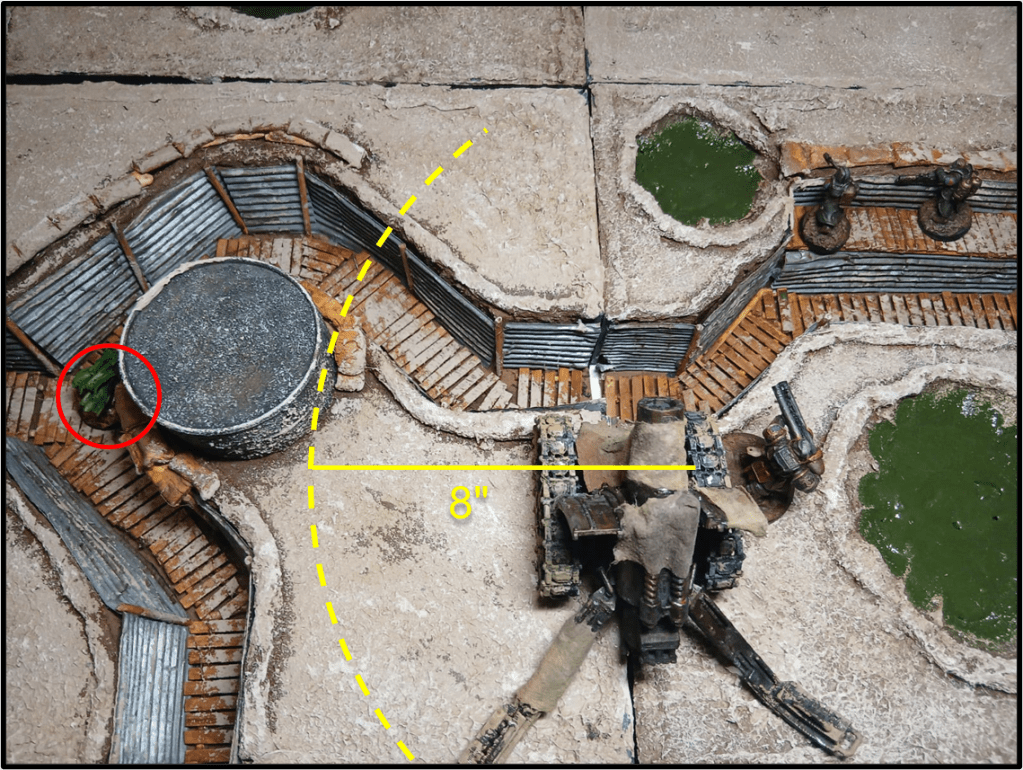
LEADER: As long as this model is not taken Out of Action, add +1 DICE to any Morale tests the warband has to take.
Currently, only models that are mandatory when a warband is first created (namely Heretic Priest, Yüzbaşı, War Prophet, Lieutenant, Lord of Tumours and Praetor) have the LEADER keyword. It’s important however to note that Cult of the Black Grail and Court of the Seven-Headed Serpent warbands do not need to start with a Lord of Tumours or a Praetor and can have a mandatory Plague Knight or Sorcerer respectively in their initial warband. More importantly, while Court warbands can acquire a Praetor later in a campaign, Black Grail warbands that start with a Plague Knight are prevented from getting a Lord of Tumours altogether (althought they get a third Plague Knight). Current playtest rules don’t grant those alternate options the LEADER keyword automatically, but considering that the FAQ state that warband variants that have a different leader option (e.g House of Wisdom, Fida’i of Alamut, Dirge of the Great Hegemon, Papal States Intervention Force) should grant the LEADER keyword to their respective leaders, it is reasonable to suppose that this would also extend to Black Grail and Court bands as well.
SKIRMISHER: When a model with this Keyword is targeted by an enemy’s Charge, it may immediately move D3” in any direction, except into Melee Combat.
A Skirmisher may also make this move when a charging enemy model would enter Melee Combat with it during a Charge that is not targeting it. After either of these moves is resolved, the Charge continues as normal toward the original target. These moves can only be taken if the Skirmisher is not in Melee Combat and only one such move may be taken per Charge.
The most obvious use of the keyword SKIRMISHER is to make a long-distance charge fail by retreating outside the charge range, but it can have other uses, for example you could move the SKIRMISHER model towards the charging enemy to intercept their charge outside the control range of an objective, or to protect another more valuable model from being charged. Also note that if the SKIRMISHER model uses this ability to move out of the attacker’s Line of Sight, this doesn’t turn the charge into a RISKY ACTION, as the model was visibile when the charge was declared.

STRONG: A model with this Keyword ignores the rules for weapons/armour/equipment with Keyword HEAVY, including not being limited to carrying only one HEAVY item (though other limitations apply as normal). In addition, it may use a single two-handed Melee weapon as a one-handed weapon.
To break it down a bit more STRONG serves two main purposes:
- Ignore the effects of the keyword HEAVY, meaning a STRONG model can have any number of HEAVY items (which usually translates into a HEAVY melee and a HEAVY ranged weapon) and more importantly, it can move/dash and fire with any weapon, and add d6″ to its charge move (d3″ if wearing mechanized armour), regardless of which items it is equipped with, thus being a lot more mobile.
- Wield a single two-handed melee weapon (regardless of whether it’s HEAVY of not) in one hand, thus leaving the off-hand free to wield another non-HEAVY weapon or an item such as a shield, musical instrument or banner.
Note that the latter doesn’t apply to CUMBERSOME weapons, which always count as two-handed regardless of any ability their wielder may possess. Also it’s important to remember that the general rules about using two melee weapons in combat state that a two-handed weapon wielded with one hand by a STRONG model is always carried in that model’s main hand, and must always be used before the off-hand weapon when making Melee Attack ACTIONS.
TOUGH: If a TOUGH model would be taken Out Of Action, it is knocked Down instead. After a TOUGH model has been knocked Down in this way once, it can be taken Out of Action as normal.
And finally the alphabetical order brings us to TOUGH. This keyword allows a model to survive the first Out of Action result it suffers during the battle, converting it into a Down effect. Note that the model would suffer BLOOD MARKERS as if the “Warrior Down” result was rolled on the Injury Table (so 1 BLOOD MARKER, or 2 markers if the model was already Down when the injury roll was made).
Taking a TOUGH model Down through any other effect does not count: TOUGH is utilized only when the model would go Out of Action for the first time, even if the subsequent Down result is negated somehow (e.g. through the Too Proud to Fall Pride Goetic Power)
Note that, as written in the item’s description, the ability of the Machine Armour to turn a Down result to a Minor Hit cannot be combined with TOUGH: in that case the model would go Down. While not explicitly written, it is reasonable to think that skills with a similar effect like Stand Firm or Sixth Sense interact with TOUGH in the same way.
On the other hand the Pride Goetic Power Too Proud to Fall, that lets the model ignore the Down result outright (but not the corresponding BLOOD MARKERS it would suffer) is explicitly stated to work in this situation. By similarity the skill Hard as Nails should interact in the same way with TOUGH.
And finally, the potentially disruptive interaction between TOUGH and GOLEM has been the subject of a heated discussion in the Trench Crusade Discord Server, particularly in relationship with the possibility for the Golem from the Book of Golem exploration location to become TOUGH via the Massive Size upgrade (the only way a model can get both keywords at once). No official changes have been made yet, so this combination is theoretically legit, but the designer has stated his intention to amend the Golem in order to avoid this interaction.

And that’s it. Now, we can only wait with trepidation for the full rulebook to release. In the meantime I still intend to proceed with introductory articles, ready to review and update them when the time is right.
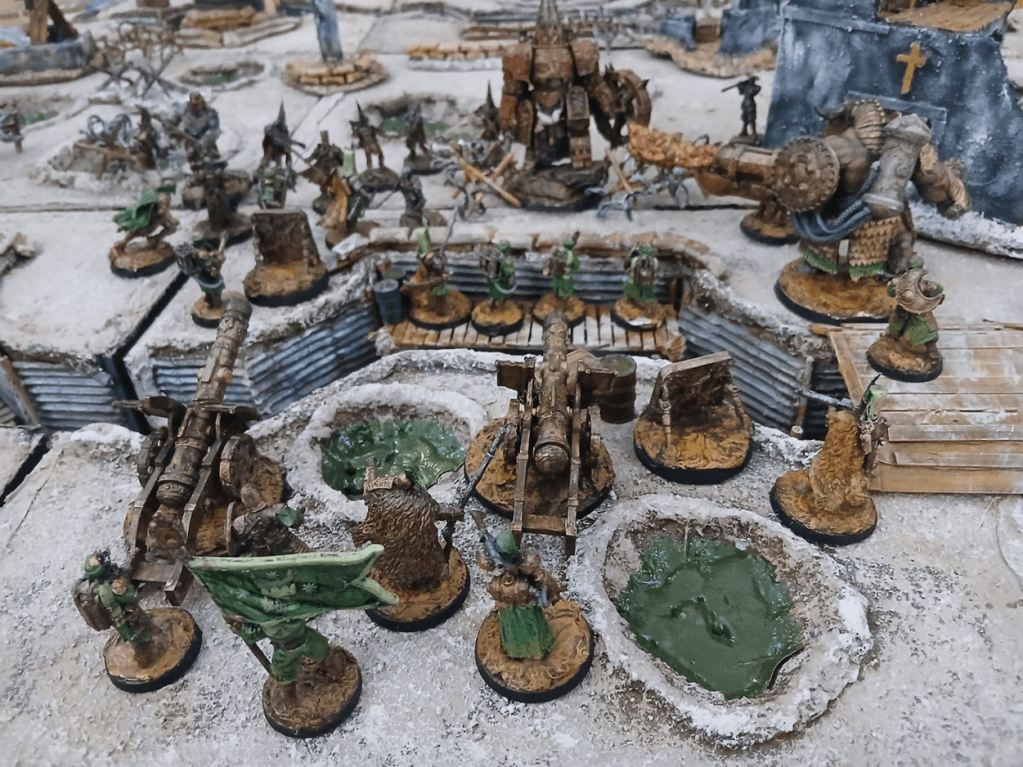
Before leaving, one last thing: a you might have noticed, with this article I decided to go for a different style for images and use pictures of my miniatures and board instead of low quality Power Point drawings. Now that my Trench Crusade collection is starting to grow (and it’s far from finished, I have at least two warbands to be painted and lot of work on the board… but more on that in the future), I thought it would be nice to add a personal touch to the site. I hope you liked it. I’m planning to update the previous posts to feature pictures as well. Until then, stay safe, keep your head down and your feet dry!



Leave a Reply