
“Would be nice if it was clearer though”
Handmade comment on the first printed edition of the New Syncretic Orthodox Bible
Anonymous – ca. 1455
LAST UPDATE: 19 February 2026

For the legacy 1.6.3 playtest rules FAQ, click here.
Foreword: This document is a collection of Frequently Asked Questions from the Trench Crusade Discord Server, with the purpose of providing a possible interpretation of ambiguous rules. Any answer provided here is either grounded in references to the official Trench Crusade Rules or is based on consensus among the Discord community members. When trying to define the best answer in an ambiguous situation, we tried to adhere as much as possible to RAW (rules-as-written) as long as it didn’t conflict with other rules, but in some cases we also offered possible interpretations based on how we feel a certain rule should be played, or what is best for the overall game experience of all players. As none of the contributors is part of the design team, no part of this document is to be considered an official ruling, and any official FAQ or clarification that contradicts what is written here takes precedence. Feel free to adopt any interpretation of the rules you see fit, as long as it doesn’t conflict with the official rules.
References to rules in answer is reported as [Document | Page Number | (Paragraph)], with the following tags used to identify documents:
- Trench Crusade Digital Rules: TCDR
- Warbands of Tranch Crusade: WoTC
For example the tag [TCDR 36 §Declare Charges] reads as “See the Declare Charges paragraph on page 36 of the Trench Crusade Digital Rulebook”.
Changes from version 1.0.1 of the rules are marked with ✎ while new entries are marked with ✵.
- (F) denotes answers that are found in the official Trench Crusade FAQ, reported here for ease of consultation (the reference number is provided). As they have been provided by Factory Fortress Inc itself, these are to be treated as official ruling.
- (R) Denotes questions whose answers can be found in the rulebook. Reference to the rules sections are provided whenever possible.
- (C) Denotes questions whose answers are uncertain or hard to determine from the rules alone. The answers provided here are an attempt at solving the questions by seeking consensus among the Trench Crusade Discord community. They are in no way definitive and their application should always be agreed upon by players beforehand.
- (?) denotes questions whose answer is not 100% clear and for which consensus was not easy to reach based on the elements we have available alone. These situations will likely require an official clarification on the FAQ or an update to the rules to be clarified once and for all. A suggestion on how to handle these has been provided, but please be aware that, even more than the issues described before, it’s impossible at this stage to know if our interpretation is correct. Always agree with your playgroup on how to handle these situations beforehand.
General Remarks
Q0.1: Rule X in the rulebook is different than what’s written in the Trench Companion / The Trench Companion Warband Builder doesn’t let me do X
A: While an excellent tool for list building and reference, the Trench Companion is not a source of rules. What is written in official documents (Trench Crusade Digital Rulebook, Warbands of Trench Crusade, official official warbands documents and FAQ) takes precedence over the Trench Companion in case of conflicting information.
Q0.2: Rule X was different in the playtest rulebook. Is the change intended?
A: While there are still some inconsistencies and potential unintended changes, it’s fair to assume that all significant changes from the playtest rules are intended.
SECTION 1 – Core & Comprehensive Rules
1. Core Game Concepts
Q1.1 – RULES Q1: In what order do players apply BLOOD and BLESSING MARKERS to the same roll?
A: If two things happen at the same time, the player who has the Initiative determines the order in which they are performed. [TCDR 32]. (F)
Q1.2 – MISC. Q1: Some models have a Base size of 30x60mm. How does this work for rules that give different effects depending on Base size (i.e. smaller or larger than 40mm)
A: Models with Bases of different dimensions (e.g. 30x60mm) count their Base size as the larger dimension (e.g. 60mm) for the purposes of rules that refer to Base sizes. (F)
Q1.3 – MISC. Q2: Does a rule that affects ‘friendly models within X”’ also affect the model with that rule? For example, can the owner of a Musical Instrument benefit from its effects?
A: Yes. A model is considered to be within X” of itself unless otherwise stated. (F)
✵ Q1.4 – MISC. Q7: Does a model have a Line of Sight to itself?
A: Yes. (F)
2. The Initiative Phase
No Q&A so far.
3. Actions
✎ Q3.1 – RULES Q8: Do all ACTIONS require making Success Rolls or Risky Success Rolls?
A: No, ACTIONS that require Success Rolls are specified in the rule text of the ACTION (or in the Comprehensive Rules section if it is a generic ACTION like Dash, Shoot, Fight, etc.). (F)
4. Movement
Q4.1 – RULES Q2: Is ‘Move or Charge or Retreat’ a single ACTION? Or are they each a different type of ACTION (a Move ACTION, a Charge ACTION and a Retreat ACTION)? If the latter is correct, can a model take more than one of them during the same Activation?
A: They are different types of ACTION: a Move ACTION, a Charge ACTION and Retreat ACTION. However, a model cannot take more than one of them during the same Activation. If you want to move a model more than once you must use a Dash ACTION instead. (F)
Q4.2: Can a model that is within 1” of an enemy charge another enemy model or move within 1” of another enemy?
A: No. A model cannot move within 1” of an enemy unless it takes a Charge ACTION [TCDR 36], but you cannot take a Charge ACTION with a model that is already within 1″ of an enemy model [TCDR 34].
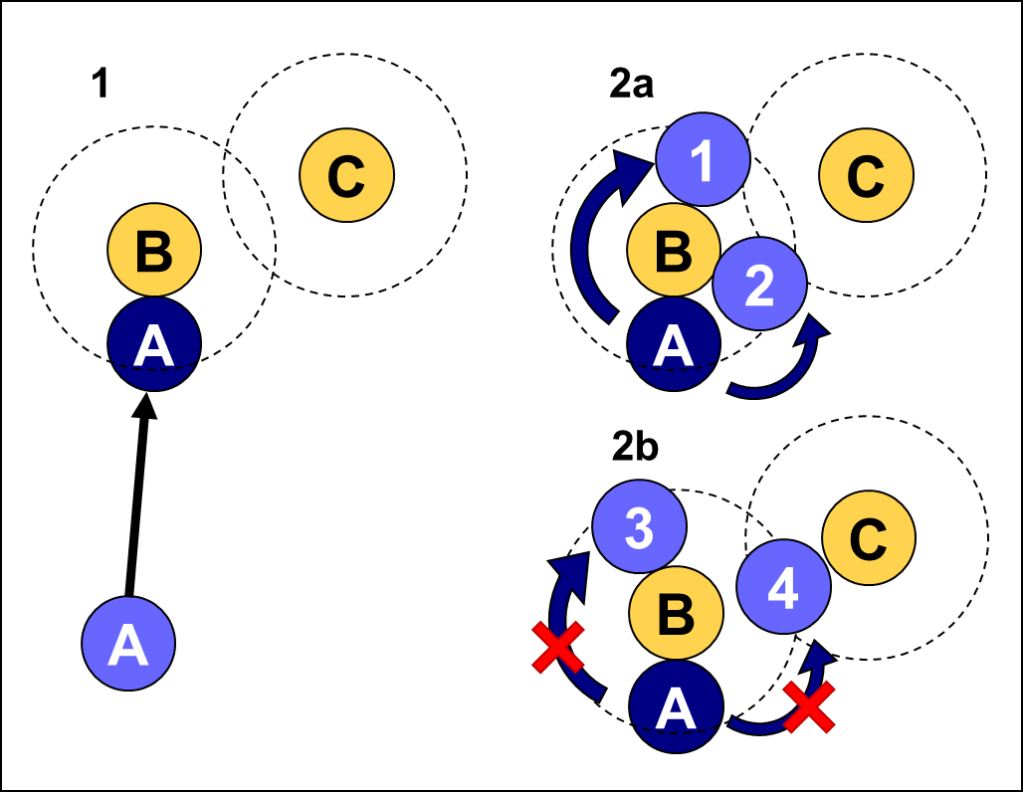
When a model starts a move within 1” of an enemy it has only two options [TCDR 35]: (1) It moves while remaining within 1” of all enemies it started the move within 1” of, but can’t get within 1” of any new enemies as per what listed above, or (2) It retreats, granting any enemy it is within 1” of a free Fight ACTION. When retreating, it cannot end the move within 1” of any enemy [TCDR 37]. (R)
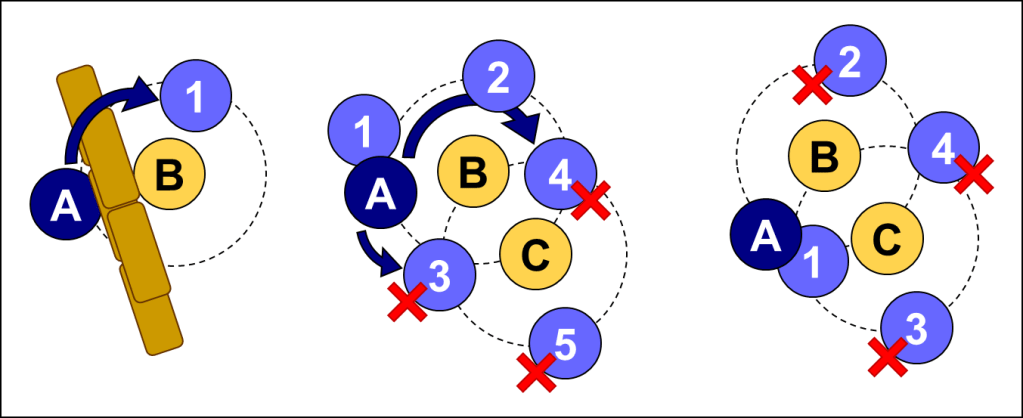
Center: A is within 1” of enemy B but not within 1” of C. If it moves (and does not retreat) it must stay within 1” of B but cannot get within 1” of C, so it can move to position 1 or 2, but not 3 or 4 and for sure not to 5 as it is not within 1” of B.
Right: Here A is within 1” of both B and C, so its movement capabilities are very limited. It cannot get to position 2 or 3 as it would leave the 1” range from one of the enemies, but it also can’t get to 4, as it must remain within 1” of both enemies throughout the entire move, and it has no room to pass between them.
Q4.3: Can a mode make a “curved” charge to ignore enemy models or obstacles?
A: No. A model who is charging must move by the shortest route available that takes it directly towards the target [TCDR 37]. This usually means charging in a straight line unless there is impassable terrain in between.
A model cannot charge an enemy if that would make the path of the charge pass within 1” of another enemy [TCDR 36 §Interposing Enemy Models].
The only situations in which a model can choose an alternate path for the charge are when the shortest route available would make the model pass through Dangerous Terrain, make a Risky Success Roll to Climb or Jump, or take a Diving charge, potentially ending their activation or suffering damage. (R)
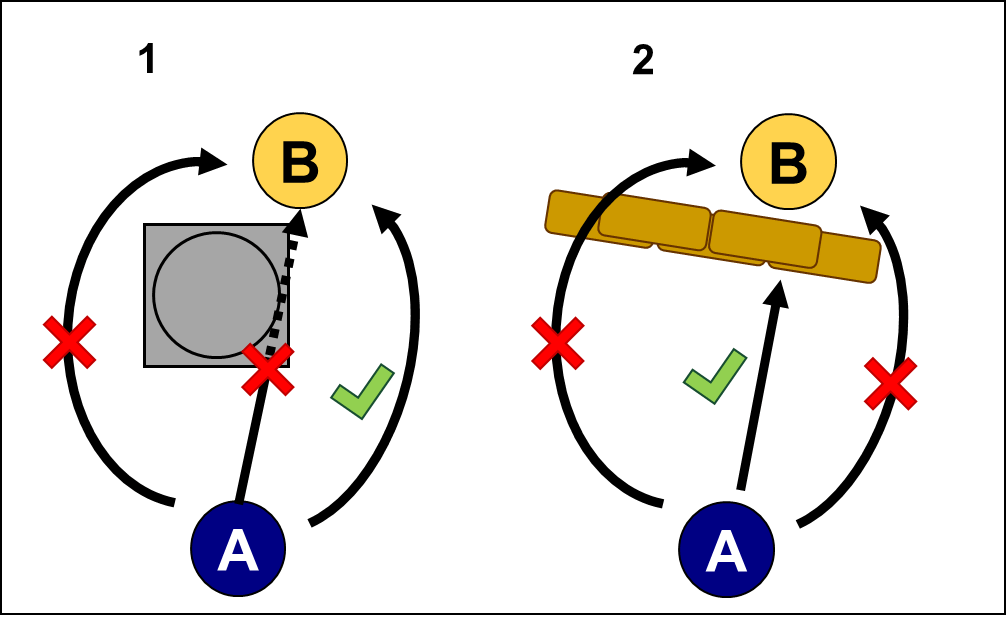
1) A cannot charge B through the most direct path, because there is impassable terrain between them. It can however charge around the impassable terrain in order to reach B. Note that it still needs to be along the shortest path, so A cannot charge to the left of the column.
2) There is an obstacle between A and B. In this situation A must charge directly towards B and cannot avoid the Defended Obstacle.
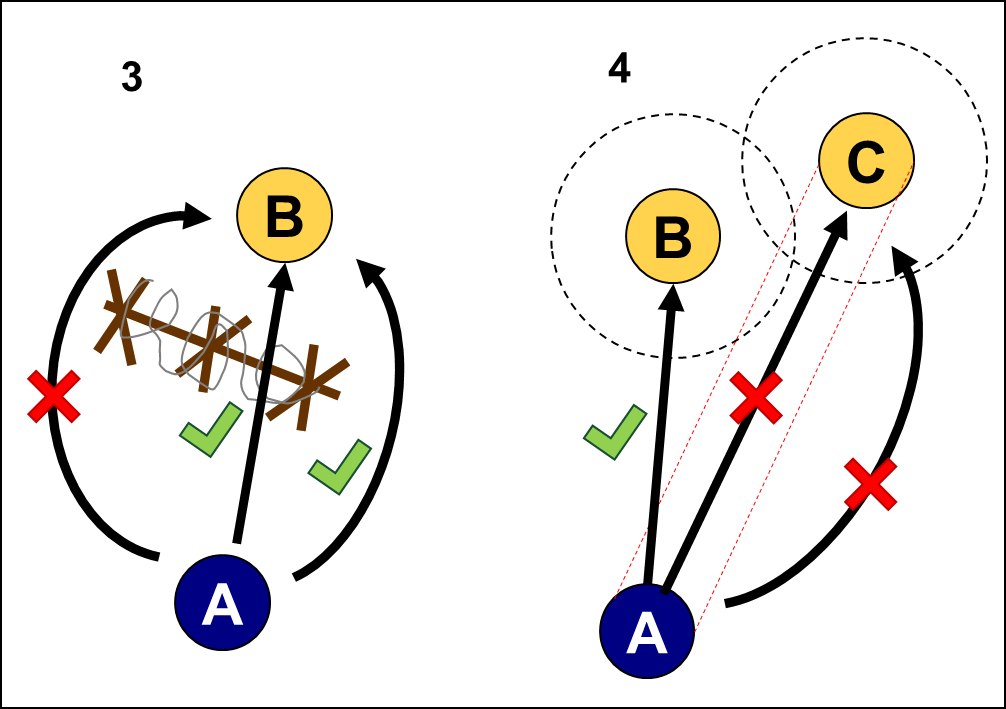
3) Dangerous Terrain is between A and B. A can choose whether to charge directly towards B, suffering the consequences of crossing Dangerous Terrain, or to move around the barb wire during the charge. As before, if it moves around the terrain, it has to follow the shortest path.
4) A cannot charge C, because doing so would have it pass within 1” of B. As the charge must be along the shortest route possible, A cannot choose to move to the side to avoid B. In this situation A must either charge B or not charge at all.
Q4.4: How does charging multiple enemies work?
A: First of all, a model would need to charge a single enemy target. After it has reached the target, the charging model can use any remaining movement it has, to move around the target, but only if (1) it remains in base contact with the target of the charge and (2) this movement allows the charging model to get within 1” of other enemy models. (R)
Q4.5: What happens if a model fails a charge? Does it remain where it is and does not move?
A: A model that declares a charge must commit to it and move as far as possible towards the target [TCDR 37]. You only check whether the charge is successful or it is failed after the charge move is completed: if the charging model is now within 1” of the target, the charge is successful, otherwise it counts as failed. Note that failing a charge only means the model is not in range to make a Melee Attack for the activation, but it can perform any other action, such as Dash, as usual. Remember however that a model can only make a Shoot ACTION with a weapon with the ASSAULT keyword in the same activation in which it charges. (R)
✎ Q4.6 – RULES Q7: Can a model move through windows in buildings or narrow gaps in general?
A: A model cannot move through any space (e.g. a window, a corridor, a gap between terrain pieces) that is smaller than its base size. If a model has a base with two dimensions (e.g. 30mm by 60mm), use the smaller dimension when determining if it can move through a space. (F)
Q4.7 – RULES Q3: Can you declare a Retreat ACTION for a model even if it is unable to move?
A: Yes. However, even though the model cannot move, it is still subject to being attacked as it had Retreated (unless stated otherwise). (F)
Q4.8 – RULES Q4: How does being placed on the other side of a gap after Jumping Over a Gap work? Can a model with a Movement Characteristic of 6” use 3” of movement before making a jump of 3”?
A: Any movement required to place the model on the other side of a gap is treated as being ‘free’ movement, as long as the total of the move up to the gap and the distance of the gap itself is less than or equal to the model’s Movement Characteristic. For example, a model with a Movement Characteristic of 6” can use 3” of movement before making a jump of 3”, with the extra movement required to place them and their base on the other side of the gap being ‘free’. (F)
5. Ranged Attacks
Q5.1: Can a model shoot with a Ranged Weapon and throw a Grenade in the same activation?
A: No. Unless explicitly allowed by a special rule, a model can only perform a single Ranged Attack during a Shoot ACTION [TCDR 42]. (R)
Q5.2: Can a model armed with two Pistols make two Ranged Attacks in the same activation?
A: No. When making a Ranged Attack, Pistols follow the normal rules for Ranged Weapons so only a single Pistol can be used to attack at range [TCDR 42]. However when making Melee Attacks a model armed with two Pistols can choose to use both as 1-handed Melee Weapons (suffering the standard Off-Hand penalty for the second attack). (R)
Q5.3: How does a weapon that fires multiple shots interact with shooting at models in melee?
A: As per the AUTOMATIC keyword rules [TCDR 53], each shot is a separate Ranged Attack, which is resolved individually using steps 2 to 6 of the Ranged Attack Sequence. During Step 2 “Select Target” of each attack you determine randomly if you hit a friendly or an enemy model (see [TCDR 42 §Shooting into Melee]) and then proceed to resolve the Ranged Attack as usual.(R)
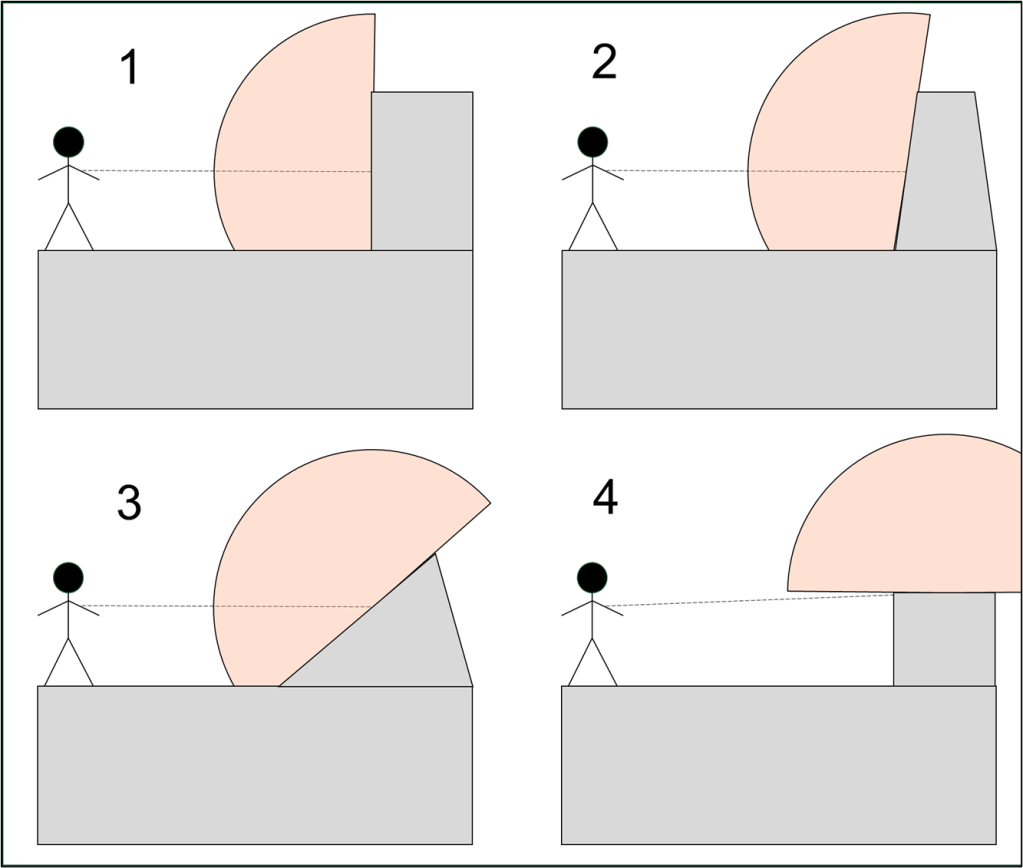
✎ Q5.4: Can a ranged attack with the BLAST keyword target a point on a vertical surface?
A: Rules-as-written, any point in range and visible to the attacker is valid as the BLAST keyword poses no additional restrictions. However we are aware that this is in conflict with a previous interpretation we suggested (only allow the target point to be placed on a surface where a model could stand – see image 3 and 4 below) which was based on the information available at the time (i.e. the target having to be “a model or a point on the battlefield” without any reference to terrain) and that this new interpretation is not agreed upon by everybody. Pending an official classification the suggestion is to play rules-as-written as any other interpretation adds restrictions that are not found in the rules. (?)
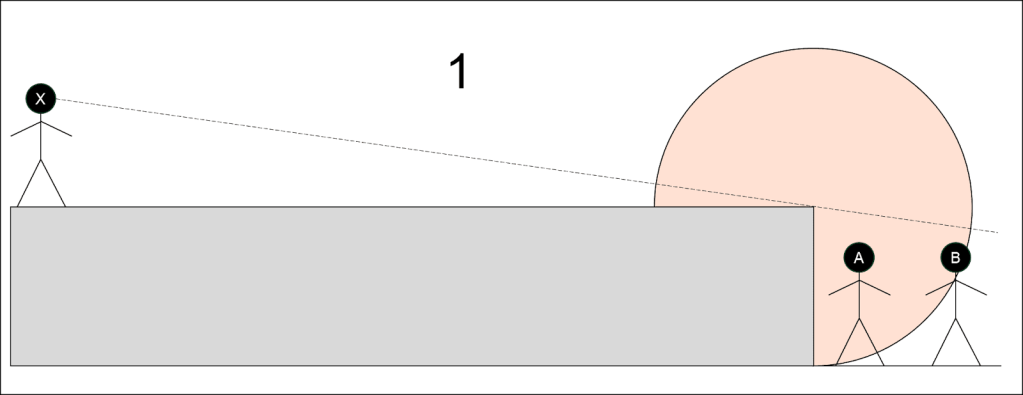
✎ Q5.5: KEYWORDS Q8: If I throw a grenade onto the lip of a trench or a ledge, does the blast hit models that are in the trench or below the ledge?
A: It will hit any model that has a Line of Sight to the target point, and whose base is within the blast radius for the grenade. In the example below, model A would be hit by the grenade, but model B would not be as its base is not within the blast radius of the attack.
Q5.6 – RULES Q5: When I shoot into a combat that has multiple friendly models and roll the 1-3 result that makes me target a friendly model, can I pick a friendly model that is in that combat but is out of Line of Sight of the shooting model?
A: No. You can only choose a model that can be chosen as a target by the attacking model (i.e. is visible to the attacking model and in range of the weapon being used). If there is no such model, the attack is wasted. (F)
✵ Q5.7 – KEYWORDS Q7: If I am checking the Line of Sight to a point on the battlefield or terrain piece, can I check the Line of Sight to any part of the 1mm by 1mm point, or must I be able to see the centre of the point? And is the point considered to be 1mm high?
A: You can check the Line of Sight to any part of the point. The point is considered to be 1mm high. (F)
6. Melee Attacks
✎ No Q&A so far.
7. Injuries
Q7.1: When an Injury Roll is converted to a Bloodbath Roll, can it be modified by BLOOD MARKERS, Armour and any other effects that affect an Injury Roll?
A: All +/- INJURY DICE and +/- INJURY MODIFIERS that would apply to the attack still apply to a Bloodbath Roll as if it were an Injury Roll [TCDR 47]. It is implied that any other effect that applies to an Injury Roll applies to a Bloodbath Roll as well. (R)
✎ Q7.2 – RULES Q9: When a model takes an Injury Roll from an effect that isn’t an attack, who rolls the dice, and who can spend BLOOD/BLESSING MARKERS?
A: You always roll Injury Rolls for enemy models, spend the BLOOD/INFECTION MARKERS that enemy models have, and spend the BLESSING MARKERS that friendly models have. Likewise, your opponent always makes the Injury Rolls for your models, spends the BLOOD/INFECTION MARKERS that your models have, and spends the BLESSING MARKERS that their own models have. (F)
✎ Q7.3 – RULES Q10: Is a BLOOD MARKER placed next to a model that is taken Down in ways other than by Injury Rolls (such as the Away, Serpents! power of an Eire Trench Cleric)?
A: Yes. Being “taken Down” is synonymous with “suffer the Down result from the Injury Table”.
✎ Q7.4: Do effects that prevent a model from suffering a Down Result (e.g. the Standfast ability of Machine Armour) work against any effect that would take the model Down (e.g. Away, Serpents!) or only against the Down result of an Injury Roll?
A: As Being “taken Down” and “suffer the Down result from the Injury Table” are synonymous [TCDR 46] any effect that prevents a Down result will also prevent the model being taken Down directly and vice versa. (R)
Q7.5: When a model goes Down within 1” of a ledge, what is the sequence of events to follow? Does the model receive a BLOOD MARKER and/or go Down before taking a Success Roll to avoid falling?
A: According to [TCDR 49] when a model would be taken Down within 1” of a ledge, you would first take a Success Roll. If successful, the model is taken Down (and suffers the BLOOD MARKER) but it doesn’t fall. On a failure the model falls and is then taken Down. (R)
✵ Q7.6 – RULES Q6: Sometimes an ability or special rule will say that an INJURY DICE or INJURY MODIFIER applies “for a model”. For example, Artificial Life for the Lion of Jabir says “Add -1 INJURY DICE to Injury Rolls for a Lion of Jabir”. Does the modifier apply to Injury Rolls made for the model, or to Injury Rolls for attacks made by the model?
A: It applies to Injury Rolls made for the model. It does not apply to Injury Rolls for attacks made by the model. (F)
8. Morale
Q8.1: If both players are forced to take a Morale Check at the end of the Turn, who rolls first?
A: As Morale Checks would happen at the same time, the player with Initiative determines the order in which they are performed [TCDR 32]. (R)
Q8.2: If my warband is Shaken, do I have to take a Morale Check at the end of the last Turn of the game? Even if I am winning?
A: Yes. If your warband becomes Shaken at the end of the second-to-last round you need to take a Morale Check at the end of the last round, regardless of who is winning the game. You might have a temporary Victory Points advantage but it’s not over until it’s over. (R)
9. Keywords
✎ Q9.1 – KEYWORDS Q6: If I target an enemy model with a weapon that has the BLAST Keyword, where do I measure the blast radius from on the target model?
A: It is measured from the centre of the model’s base. Note that if an attack scatters and ends up on another model’s base, in this instance the blast radius is instead measured from the point on the new model’s base that the attack scattered to (rather than the centre of the new model’s base). (F)
✎ Q9.2 – KEYWORDS Q10: Can I still charge a model that has the SKIRMISHER Keyword if it moves out of the charging model’s Line of Sight?
A: Yes. (F)
Community FAQ note: Line of Sight is checked when the active model is declaring the target of the charge [TCDR 36 §Declare Charge]. SKIRMISHER is triggered when a model is chosen as the target of a charge [TCDR 57] so when the check for line of sight has already been done. The charging model can then follow up with the charge towards the target’s new position.
Q9.3 – KEYWORDS Q1: Can I target the point under a model’s base with a BLAST weapon?
A: No. You can only target a point on the Battlefield that is in the attacking model’s Line of Sight – and the LoS to the ground under the model is blocked by the model’s base. (F)
Q9.4 – KEYWORDS Q2: If I Activate a model in a FIRETEAM as an individual model, can I then Activate the second model later in the Turn as a FIRETEAM – therefore gaining a second Activation for the model that Activated first as an individual?
A: No. (F)
Q9.5 – KEYWORDS Q3: Do Keywords like IGNORE ARMOUR or IGNORE (MODIFIER) also ignore the Special Rules or Abilities granted by that Armour or the source of the Modifier?
A: No. (F)
Q9.6 – KEYWORDS Q4: Do weapons with the PISTOL Keyword with the effects of a type of ammunition (i.e. Incendiary Ammunition, Armour-Piercing Bullets, etc.) gain the benefits of said ammunition when they are used in melee combat?
A: Yes. (F)
Q9.7 – KEYWORDS Q5: How does the TOUGH Keyword interact with other rules that prevent a model from being taken Down?
A: You follow the rules as written, and apply them one after the other in the order they occur. For example, a Lieutenant with the TOUGH Keyword wearing Machine Armour is taken Out of Action for the first time in a game. The TOUGH Keyword means that the Out of Action Injury result is treated as a Down Injury result the first time it is rolled, and Machine Armour has the Standfast rule which means that, when a model in Machine Armour suffers a Down result, it is treated as a Minor Wound result instead. This means that the Lieutenant does not suffer the Out of Action result, but instead suffers the Minor Wound result. The next time they suffer an Out of Action result, they are taken Out of Action as the TOUGH Keyword only alters the Injury result the first time it is rolled. (F)
Q9.8: When an effect (e.g. Voice of God, Faithful Followers, Hold Your Fire!) requires a player to pick a model to be activated, and the chosen model is part of a FIRETEAM, can that model’s controller choose to activate the other member of the FIRETEAM as well?
A: Yes (C)
✵ Q9.9 – KEYWORDS Q9: Model A is in contact with enemy Models X and Y. Enemy model X is hit by a BLAST, but models A and Y are not in the blast radius of the attack. I know that model A is hit by the attack – because it is in contact with model B – but is model Y also hit because it is in contact with model A?
A: No. (F)
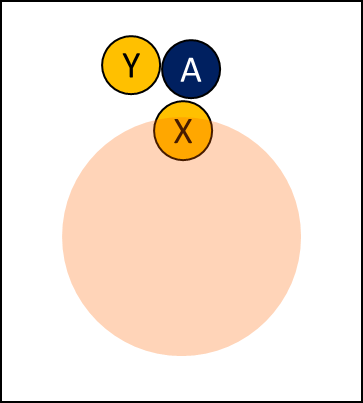
Community FAQ note: The question assumes that A is friendly to the model that made the BLAST attack, as if it were an enemy, it wouldn’t be hit. Also note there’s a potential typo in the official Rules Commentary and “model B” should probably be read “model X”
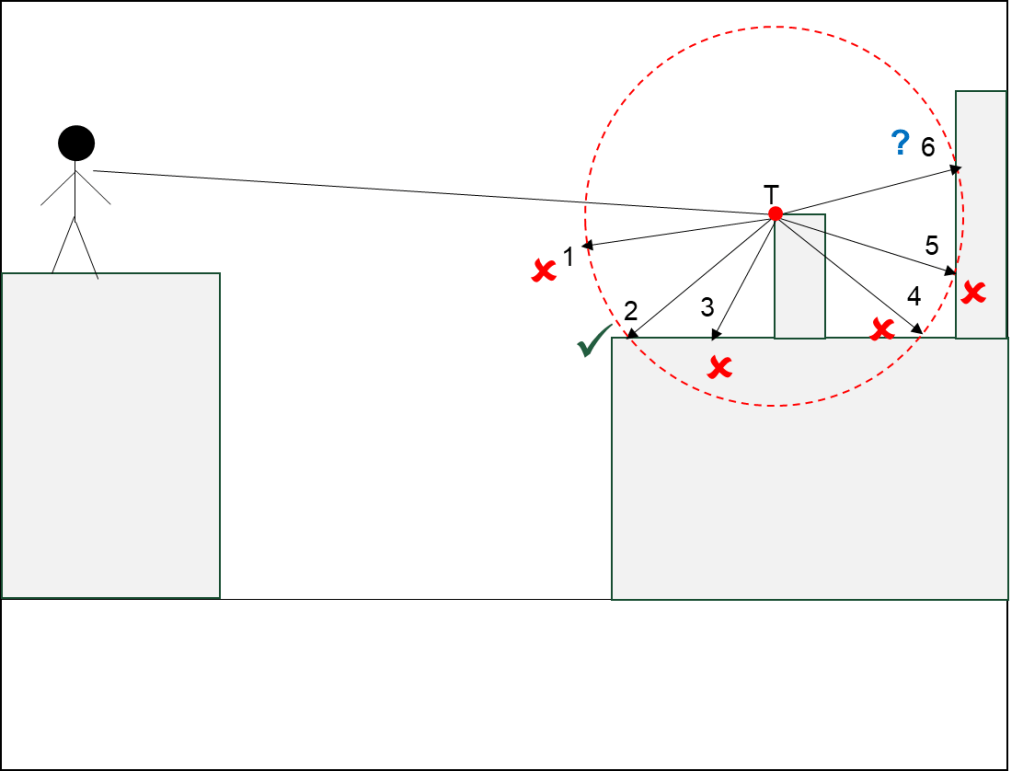
✎ Q9.10: What happens when the target point of a BLAST attack scatters across a ledge, or over a raised obstacle due to the SCATTER Keyword?
A: The point where the attack lands after a SCATTER of X inches has to satisfy all the following conditions
- It must be a point on the battlefield, on a terrain piece or on a model’s base ( point 1 in the image below is not valid as it is in mid-air)
- It must be in Line of Sight from the point/model that was the original target of the attack (points 4 and 5 are not valid as the line of sight from T is blocked)
- It must be exactly at X” of distance from the original point (point 3 is not valid as it is closer)
If no point exists that can satisfy all the conditions, the attack misses outright. If multiple points satisfy the condition, the opponent chooses where the attack lands among the valid points..
Note that in the image below, 2 is a valid point, while 6 can be valid, depending on the answer to Q5.4 above. (R)
10. Terrain
Q10.1: Obstacles up to 1” high can be crossed as Open Terrain. Does it mean a model can ignore them when moving ?
A: No, an obstacle counting as Open Terrain only means you do not have to take a Risky Success Roll to climb anything that is 1” or lower. Movement can be in any direction [TCDR 35], including vertical, and the vertical distance still counts towards the model’s movement for the current ACTION (e.g. a model with a Movement Characteristic of 6” that crosses a 1” high fence will only move up to 5” across the battlefield for that ACTION). (R)
Q10.2: Does a model need to make a Risky Success Roll in order to climb out of a Trench?
A: As specified in the Terrain section [TCDR 62 §Trench Sections], the side of a trench can be crossed as if it is Open terrain if it is less than 3″ high, but must be Climbed or Jumped Down from if it is at least 3″ high.
Note that, as above, the side of a trench counting as Open Terrain does not mean you ignore the vertical distance moved, only that no Risky Success Roll to climb is required. (R)
Q10.3: I’ve followed the suggested terrain setup rules and my battlefield doesn’t look dense enough. Have I done something wrong?
A: Remember that the provided rules for setting up terrain [TCDR 65, 66, 67] are presented as guidelines and suggest adding at least the listed number of terrain pieces. Here’s a few more suggestions you might want to take into consideration when building your battlefield:
- The denser the board is, the better. Remember that, due to how Cover works in Trench Crusade, if a model can see an enemy, having multiple obstacles between the shooter and the target would not affect the attack if the target is not adjacent to terrain. Many weapons also have the IGNORE COVER keyword therefore it’s important to have obscuring terrain to prevent models from being shot down easily.
- For the same reason, avoid creating “firing lanes”: areas where a model can see unobstructed from one deployment zone to the other and terrain that provides elevation in or close to deployment zones are to be avoided to prevent long range weapons from dominating the battlefield. Diagonal or sideways firing lanes are acceptable though, as they reward maneuvering and tactical plays.
- Take into account the size of terrain pieces relative to the size of the board, not just their number. The suggested setup rules list 14 pieces, up to 8”x8” each. If all are at their maximum size, they’ll cover about 69% of a 3’x3’ board, or 39% of a 4’x4’ board. Try to aim at least as 50%, and count multiple smaller terrain pieces as one of a similar area (for example, four 4” x 4” pieces cover the same footprint of a 8” x 8” piece and should therefore count as 1 item, not 4).
- Verticality is an important part of the game. Don’t leave it out. Use terrain that can be climbed upon at least 3” above the ground so that the Elevation and Diving Charge bonuses can be used and models can risk taking damage when falling. Use planks and walkaways to connect elevated terrain pieces to create alternate routes.
- While Dangerous and Difficult Terrain should be part of the game and makes for interesting boards, avoid having too large areas. The same for obstacles, sheer surfaces and deep trenches: models should always have the option to move around the board with relative ease. Covering half of the battlefield with Difficult Terrain will disincentivize movement and lead to static, unfun games.
- Give players tactical options, particularly around objectives. Spread out cover and obscuring terrain so that models can advance slowly and safely, or can take risks in order to move quicker. Allow multiple paths to get to objectives and let the player figure it out what is the best one. (C)
11. Battlekit
Q11.1: Can a model use an Automatic Pistol to make two Melee Attacks during a Fight ACTION?
A: No. The AUTOMATIC keyword [TCDR 53] allows the model to make multiple Ranged Attacks with the weapon. When used as a Melee Weapon, a weapon with the PISTOL Keyword is making Melee Attacks [TCDR 56], so it won’t grant the additional attacks from AUTOMATIC.
Note also that any modifiers to Ranged Attacks won’t apply to a PISTOL weapon used in melee, while modifiers to Melee Attacks will apply. (R)
✎ Q11.2: Is a model equipped with (a) a 2-handed Melee weapon and a Pistol, or (b) a Shield or HELD Item, a 1-handed Melee weapon and a Pistol capable of using both the Melee Weapon and the Pistol to make Melee Attacks during a Fight ACTION?
A: No. The model is limited to what their hands allow them to use and can only switch weapons between ACTIONS [TCDR 69 §Two Hands, One Head and a Body]. (R)
✎ Q11.3: The rules for Battlekit restrict a model to carrying either a 2-handed Melee Weapon or two 1-handed Melee Weapons. Does this mean a model with the STRONG keyword can only use a 2-handed Melee Weapon in one hand and either a Shield, a HELD Item or a 1-handed ranged weapon with the PISTOL keyword in the other?
A: A: No. A STRONG model can equip a single 2-Handed Melee weapon as if it were a 1-Handed melee Weapon [TCDR 57], therefore it can wield a 2-handed Melee Weapon in one hand combined with either a 1-handed Melee Weapon (e.g. Greatsword/axe + Trench Club), a Shield or a HELD item. (R)
Q11.4: What does the fact Grenades are not Ranged Weapons entail?
A: The following are consequences of Grenades not being Ranged Weapons:
- The following Ranged Skills do not apply to Grenades: Point Blank, Hip Shot, Headshot.
- A model with the Wrath of God ability in the Procession of the Sacred Affliction is prevented from having Ranged Weapons, but it can have Grenades.
- The Jabirean Alchemist Mastery of Elements ability only works on Melee Weapons and Ranged Weapons so it doesn’t apply to Grenades.
- A Plague Knight cannot use the Knight of the Rotten Cross ability to acquire Grenades
- Heralds of Beelzebub can only take Ranged Weapons, so they can’t have Grenades.
- Yoke Fiends can take up to 1 Ranged Weapon that costs 30 ducats or less, while the rest of Battlekit has no limit so they can take both a Ranged Weapon and one type of Grenades.
- The Mendelist Ammo Monk’s Cartridge of His Wrath ability only affects Ranged Weapons so it can’t give BLAST(2) and SHRAPNEL to Grenades (note that the other two options of the Ammunition Sacrament ability affect all Ranged Attacks made by the model, including those made with Grenades). (R)
Q11.5 – BATTLEKIT Q1: Why do the pieces of Battlekit in the Standard Battlekit and Glory Item sections of the rules not have the stipulations (like Bayonet Lug, Shield-Combo, etc) included in their descriptions, as they are when they appear in the Faction Lists? Is this a mistake?
A: No. The Battlekit in the Standard Battlekit and Glory Item sections can be used by several different Warbands, and sometimes the stipulations for the different Warbands will be different. Because of this we decided not to include the stipulations in the Standard Battlekit and Glory Item sections of the rulebook. For example, the forces of New Antioch are relentlessly drilled in the art of bayonet fighting, granting their Shotguns the Bayonet Lug stipulation. However, the hordes of the Court of the Seven-Headed Serpent see little reason to entertain the mundanities of the bayonet, instead opting for more arcane and brutal weaponry when they face their enemies up close. Therefore, their Shotguns do not have the Bayonet Lug stipulation. (F)
Q11.6 – MISC. Q3: I have some models in my collection that carry some items of battlekit that the rules don’t allow them to use, just because I think they look great modelled that way. For example, I’ve made one of my models with a rifle slung on its back, holding a pistol in one hand and a trench club in the other. By the letter of the rules this model can’t be used, because it has a 2-Handed Ranged Weapon (the rifle) and a 1-Handed Ranged Weapon (the pistol). Is it okay for me to use the model if I don’t use the rifle during the game? If the answer is yes, do I have to pay the cost of the rifle even though I won’t use it?
A: It is definitely okay to use your model in a game – the rule of cool takes precedence in this case. If you do, any extra Battlekit that you add is considered to be purely decorative, and you cannot use it and do not have to pay its cost in ducats. It is also ignored when working out the range or Line of Sight to or from the model. However, if you use a model like this in a game, you must tell your opponent which Battlekit is decorative at the start of the game, before either side deploys. (F)
✵ Q11.7 – BATTLEKIT Q2: Can a model that has the STRONG Keyword use a Shovel as a 1-Handed Melee Weapon?
A: Yes (F)
12. Warband Building
Q12.1: How many Ducats and/or Glory am I allowed to spend to create my warband for a one-off game? Is there a limit to the number of models I can field?
A: Any amount of ducats, glory and models you and your opponent agree upon. The rules [TCDR 145] suggest a value of 700 ducats for your first games, and of 800 Ducats and 6 Glory once you have started to grasp the mechanics of the game but any value can go. 900 Ducats and 8 Glory is a common game size as it was the standard during the game’s playtest, for example. As per models, there is no defined limit in the rule but we suggest to stick with the maximum field strength of a campaign warband of equivalent value [TCDR 98] so 10 models in the case of a 700 ducats warband, 11 for 800 Ducats/6 Glory and 12 for 900 Ducats/8 Glory.
Be aware that if you are still familiarizing yourself with the rules, games with over 900 ducats/12 models per side could become long. (R)
Q12.2: Is my warband required to have a “leader” model (e.g. Lieutenant, Heretic Priest) all the time?
A: No. As written in [WoTC 13] “Most Faction Lists include a model that must be taken when the Warband is created, usually representing the commander of the Warband”. Besides being mandatory when the Warband is created, there is no requirement for that model to be recruited again if it leaves the Warband for whatever reason. (R)
Q12.3 – STARTING A WARBAND Q1:When I have a special rule that allows me to purchase Battlekit from other Factions Armoury Tables, does that Battlekit still come with the stipulations from the other Armoury Table (i.e. ELITE only, Shield Combo, Limit: 1, etc.)?
A: Yes. Battlekit purchased from an Armoury Table always comes with the listed stipulations unless stated otherwise. (F)
Q12.4 – STARTING A WARBAND Q2: Do weapons with dual-types such as Pistols or Halberd-Guns count towards both limits of Ranged and Melee weapons that a model can have?
A: No. Weapons count towards the limit of the same type they are purchased from on an Armoury Table. For example, a Pistol counts as one 1-handed Ranged Weapon, whereas a Halberd-Gun counts as one 2-Handed Melee Weapon. (F)
Q12.5 – STARTING A WARBAND Q3: If I have a Shield, can I have a 1-Handed Melee Weapon AND a 1-Handed Ranged Weapon?
A: Yes. (F)
✵ Q12.6 – MISC. Q4: Do the Corrupt Merchants and Weapon Collections special rules only allow me to purchase one of each piece of Battlekit that I choose, or can I purchase multiple copies of the same Battlekit?
A: You can only purchase one of each piece of Battlekit.
SECTION 2 – Campaign Rules
13. Campaign Games Setup and Pre-Battle Sequence
Q13.1: For Scenarios that require players to count the number of models in your warband, for example to determine attacker and defender in Supply Raid, is the number counted before or after using pre-battle abilities like Broken on the Wheel ?
A: To determine attacker and defender you count the number of total models in your warband, before picking Forces [TCDR 161, 176, 187] so any model not brought to the battle, and models that are placed on the Wheel of an Anchorite Shrine do count for the total. (R)
14. Campaign Phase
✎ Q14.1: Can I promote more than a model in the same Promotion & Experience Step?
A: Yes. [TCDR 104 §Roll Promotion Dice].” You roll dice assigned to a model one at a time. As soon as you roll a 6, you stop rolling for that model and Promote the model you were rolling for as described next. Then roll for the next model…” (R)
Q14.2: Does a newly promoted ELITE model start gaining Experience Points immediately after promotion?
A: Yes. Experience is assigned after promotion rolls have been made, and there are no restrictions for models that have been just promoted [TCDR 104 §Experience]. (R)
✎ 14.3 – CAMPAIGNS Q5: When a Warband has the chance to choose between two different Exploration Tables during the Exploration Step, is the table chosen before or after rolling?
A: Before. (F)
Q14.4 – CAMPAIGNS Q1: Do you HAVE to make Promotion Rolls and/or assign Promotion Dice?
A: Yes. When your Patron or your High Command deems it right to promote a member of your Warband, it would be unwise to refuse. (F)
15. Skills
✎ 15.1 – CAMPAIGNS Q4: Do Skills that increase the Limits for things that can be taken by certain models in the Warband (e.g. Logistical Skills, Sultan’s Favour) apply to models in Variant Warbands (such as the Holy Warriors in a Expeditionary Forces of Abyssinia Warband)?
A: Yes. (F)
Community FAQ note: Consensus is these skills can increase any model’s Limit, including instances not explicitly worded as “Limit: 0-X”, such as “cannot have more than X copies of model Y” (e.g Mechanized Heavy Infantry in a Stosstruppen of the Free State of Prussia Warband).
However if a Warband cannot include a particular model (e.g Defenders of the Iron Wall cannot include Lions of Jabir) then increasing the Limit won’t have any effect: you still cannot have that kind of model.
✎ 15.2 – CAMPAIGNS Q2: Does the Gunslinger skill from the Ranged Skills table in the Campaign Rules allow a model armed with a pair of automatic pistols to make two attacks with each pistol?
A: Yes. Make two attacks one after the other with the first pistol using its AUTOMATIC 2 Keyword, and then use the Gunslinger skill to use the second pistol to make two more attacks one after the other. (F)
✎ 15.3 – CAMPAIGNS Q6: Can a model with the Gunslinger Skill and two Pistols swap one of the Pistols with a Melee Weapon when it takes a Fight ACTION? If it can and the Pistol is used to make the second Melee attack, does the IGNORE OFF-HAND WEAPON keyword apply to the attack?
A: Yes to both questions. (F)
✎ 15.4 – CAMPAIGNS Q7: Which modifiers apply to an attack made with the Point Blank Skill?
A: Use the modifiers that apply to a Melee Attack. (F)
Community FAQ note: Although it uses a Ranged Weapon and is modified by the Ranged Characteristic of the model, an attack with Point Blank is a Melee Attack [TCDR 108], therefore all modifiers that apply to a Melee Attack (e.g. the +1 INJURY DICE against enemies who are Down [TCDR 18, 48] or skills like Close Quarter Combat, Relentless Charge and Surgical Strike [TCDR 107]) also apply to a Point Blank attack, while modifiers that apply to a Ranged Attack (e.g. skills like Hunter or Headshot [TCDR 108]) do not.Note however that Strength of Samson or Champion [TCDR 107] won’t apply because a model gains the benefit of these skills only when using a Melee Weapon.
✎ Q15.9: Can a model use the Point Blank Skill against an enemy that is retreating?
A: Yes. Point Blank allows the model to make a Melee Attack with a Ranged Weapon in any situation in which it is allowed to make a Melee Attack, including when an enemy within 1” retreats. (R)
16. Glory Items
✎ Q16.1 – CAMPAIGNS Q8: Are the Glory Items in the Campaign Rules section considered to be Battlekit?
A: Yes (F)
✵ Q16.2 – CAMPAIGNS Q9: Are pieces of Battlekit that cost Glory Points in an Faction List’s Armoury Table or the special rules for a Variant Warband (e.g. the Troop Flag or the Field Shrine), considered Glory Items for the purposes of Exploration Tables?
A: No (F)
Q16.3: Can I purchase any Glory Item I want during the Quartermaster Step as long as I have the Glory to spend?
A: Although the text of “Purchase Glory Items” in [TCDR 124] might lead one to think all Glory Items are available for purchase during the Quartermaster Step, you can only acquire a Glory Item in one of the following ways:
- by making a discovery from an Exploration Table that allows you to take a Glory Item for free (e,g, Ruined House)
- by making a discovery from an Exploration Table that allows you to purchase Glory Items up to a certain value from that moment on (e.g. Black Market).
Note that these restrictions do not apply to the acquisition of Battlekit that costs Glory (e.g Troop Flag) or Mercenaries (R)
✎ Q16.4 – MISC. Q6: Can we use the Glory Items in the Campaign Rules section of the Trench Crusade Rulebook in one-off games?
A: By the letter of the rules, Glory Items in the Campaign Rules can only be taken in campaigns (see Glory Items in the Trench Crusade Digital Rulebook). However, like anything else, if you and your opponent consent to the use of certain Glory Items in a one-off game, please feel free to do so. As long as everyone at the table agrees with what is happening, there is no wrong way to play Trench Crusade! (F)
✎ Q16.5: Do Trench Dogs count towards the number of models in the Warband for Maximum Field Strength?
A: A: Yes. It is only not counted as a model in the Warband for the purposes of Morale Checks. (F)
Q16.6: If a Trench Dog and its owner form a Fireteam in a New Antioch’s Warband, do they gain the benefits of the Concentrated Attack ability?
A: Yes. The rule for New Antioch’s Fireteams [WoTC 22] states “Fireteams in a New Antioch Warband have the Concentrated Attack ability:”. It doesn’t pose any restriction beyond the Fireteam belonging to a New Antioch’s warband. (R)
Q16.7 – MERCENARIES Q1: Can a Mercy Dog drag a Downed model?
A: Yes. The rule specifically states that the Mercy Dog can move a model that is Down. (F)
17. Scenarios
✵ Q17.1 – SCENARIOS Q1: Some Glorious Deeds require that an enemy is taken Out of Action with a Ranged Attack that uses the Long Range and Cover modifiers. Can I carry out these deeds if the attack has the IGNORE LONG RANGE or IGNORE COVER Keywords?
A: No. (F)
✵ Q17.2 – SCENARIOS Q2: It is possible for both players to complete the King of the Hill Glorious Deed in the Armoured Train scenario at the same time. How is this resolved?
A: The player with the initiative decides who completed the deed first (see the box out on page 32 of the Digital Rulebook). (F)
✵ Q17.3 – MISC. Q5: I’ve been told that scenarios must be played on boards that are 3’ by 3’. Does this mean that I can’t use the 4’ by 4’ board I have made?
A: Don’t worry, you can use your 4’ by 4’ board for ALL of the scenarios in the Trench Crusade Rulebook. The scenarios are designed so that almost all of them can be played on a surface that is at least 30” across. Some require larger playing areas, but when this is the case it is clearly indicated in the instructions for the scenario. So, you can use any sized board as long as it is 30” across or larger. This means you can use a 4’ by 4’ board, a 6’ by 4’ board, or even a 10’ by 5’ board. (F)
SECTION 3 – Warbands of Trench Crusade
18. The Principality of New Antioch
Q18.1: Machine Armour cannot be combined with a Trench Shield. Does it mean that it can be combined with other kinds of Shields?
A: Yes. Rules-as-Written the prohibition is explicitly for a Trench Shield. Machine Armour can be combined with a Heavy Ballistic Shield and, if taken by other factions, such as warbands from the Knights of Avarice or the House of Wisdom variants, with any other shield those warbands may have access to, such as the Fire Shield or Holy Icon Shield. Remember however that a model cannot have a -INJURY MODIFIER better than -3 [TCDR 18, 48]. (R)
19. Trench Pilgrims
Q19.1: In a Procession of the Sacred Affliction warband, can a model with the Wrath of God ability carry and use Grenades?
A: Yes. Grenades are not specifically Ranged Weapons [TCDR 78] therefore they are always listed separately when allowed or prohibited. The model withWrath of God must be a Castigator, Trench Pilgrim or Martyr Penitent, therefore it can have any Battlekit from the Trench Pilgrim Armoury. Wrath of God prevents it from using Ranged Weapons but doesn’t explicitly exclude Grenades so they are allowed. (R)
✎ Q19.2: Are Stigmatic Nuns in a War Pilgrimage of St. Methodius Warband allowed to wear Reinforced Armour if promoted to ELITE?
A: Rules-as-Written no, they must explicitly wear Standard Armour [WoTC 63] (R)
Q19.3 – TRENCH PILGRIMS Q1: Can I resurrect a Trench Pilgrim that died as a result of being Broken on the Wheel as a Martyr Penitent?
A: No. Though the knowledge of their sacrifice is a reward unto itself, they have not earned their martyrdom. (F)
20. The Sultanate of the Iron Wall
Q20.1: When an Alchemist uses its Mastery of the Elements ability to apply the FIRE, GAS or SHRAPNEL keyword to a weapon that already has a different keyword, does the new keyword replace the original one or do they stack ?
A: Both keywords apply at once (as long as they are different), and each will apply an additional BLOOD MARKER to the injury caused by the attack . For example, if an Alchemist armed with a Flamethrower chooses GAS as the keyword for Mastery of the Elements, the Flamethrower will have FIRE and GAS. Note that effects that negate those keywords will apply individually, so a Gas Mask will negate the additional BLOOD MARKER caused by GAS but won’t affect BLOOD MARKERS caused by FIRE or SHRAPNEL. (R)
Q20.2: Is a Fida’i of Alamut Dervish allowed to wear Reinforced Armour if promoted to ELITE?
A: Rules-as-Written no, as Dervishes cannot have Reinforced Armour [WoTC 80]. (C)
Q20.3: Can you re-create a Homunculus that has been promoted to ELITE and reached 3 Battle Scars?
A: There is a strong argument towards treating a model as “killed” only if it suffers an effect that directly removes it from the warband roster (a “Dead” or “Captured” result on the Trauma Table for example), while a model that suffers 3 Battle Scars is “Unfit for Duty” [TCDR 101] and has to retire from the warband, therefore a Homunculus cannot be re-created in that situation. (?)
21. Heretic Legions
Q21.1: At which warband value do I get a second Artillery Witch?
A: The Artillery Witch Battery rule [WoTC 116] reads “You may include 0-2 Artillery Witches in a Warband if the total cost of all of the other models in the Warband (including their Battlekit, etc) adds up to 1000 ducats or more”. “All the other models in the Warband” refers to all other models besides the 0-2 Artillery Witches, therefore, as each Artillery Witch costs 100 ducats without equipment the minimum warband size required to include 2 Witches is 1200 ducats. (R)
Q21.3 – HERETIC LEGIONS Q1: Does the special rule that allows a Knights of Avarice Warband to purchase a Goetic Warlock Mercenary for Ducats stop me from being able to recruit a Goetic Warlock as a Mercenary for Glory?
A: No. This rule allows you to have two Goetic Warlocks in a Knights of Avarice Warband. (F)
✵ Q21.4 – HERETIC LEGIONS Q2: Does the Death Commando’s Stealth Generator ability affect Blast attacks?
A: Only if the attack targets the Death Commando directly. It has no effect on a Blast that targets a point on the ground. (F)
22. The Cult of the Black Grail
Q22.1: When a model without any INFECTION MARKERS activates within 1” of a Hound of the Black Grail, does it get an INFECTION MARKER from the Hound’s Disease Carrier rule first, and then a second one from The Infection Spreads rule of INFECTION MARKERS? Or does The Infection Spreads only apply to models that had an INFECTION MARKER when activated?
A: As both Disease Carrier and The Infection Spread effects happen at the same time (when the model is activated, before it carries out any ACTION), the player with Initiative determines the order in which they are performed [TCDR 32]. (R)
✎ Q22.2 – BLACK GRAIL Q1: Can a Lord of Tumours make a Crushing Blows attack if it has no Melee Weapons and/or if it has a Shield?
A: Yes to both questions. (F)
Q22.3: Can a Dirge of the Great Hegemon’s Bereaved armed with a Pistol use both its unarmed attack and the Pistol to make two Melee Attacks?
A: No. A Grail Thrall’s Overwhelming Horde rule [WoTC 137] allows it to make a Melee Attack even if it’s not armed with a Melee Weapon, but it doesn’t make the Thrall count as having a Melee Weapon, nor it grant any additional Melee Attacks.
When armed with a single Pistol, the Bereaved is considered armed with a single Melee Weapon, therefore the rule for making multiple Melee Attacks [TCDR 45] doesn’t apply. (R)
Q22.4: Can a model with the Black Grail Shield use its Power of the Cult of the Black Grail ability against an attack with the FLAMETHROWER keyword, in an attempt to roll a Critical Success and make the attack miss ?
A: Some argue you can use the Black Grail Shield against a FLAMETHROWER, because FLAMETHROWER Weapons must still go through the Ranged Attack Sequence: the Power of the Cult of the Black Grail ability triggers “when the model is chosen as a target for an attack.” (Step 2 of the Ranged Attack Sequence) while the need to make a Success Roll is checked on Step 5 at least. On the other hand, the main argument against this ruling is that, as FLAMETHROWER weapons do not make a Success Roll, this invalidates the “before the Success Roll is made for the attack” clause of the Black Grail Shield. In the end as we didn’t reach a conclusive answer, we suggest you work out with your group how to address this particular ruling, at least until it’s addressed in an official FAQ. (?)
Q22.5: Can a Plague Knight with the Knight of the Rotten Cross ability acquire a Machine Gun, even if it has the Amalgam Only stipulation? If so, does this allow a Black Grail Warband to have 2 Machine Guns?
A: While the rules are not 100% clear on the topic, consensus is that items taken from other factions’ armouries follow their own, independent set of stipulations [See also Q12.3], therefore a Knight of the Rotten Cross can have a Machine Gun and can do it even if your warband has an Amalgam with a Machine Gun. (C)
23. The Court of the Seven-Headed Serpent
Q23.1 Can a model cast multiple Goetic Spells in the same activation?
A: Yes. Although many spells require a Cast Spell ACTION to be used, a model can cast each individual spell available to it once per activation, as long as there are enough BLOOD MARKERS to spend [WoTC 147]. (R)
Q23.2 – THE COURT Q1: Can my Sorcerer make a cast spell ACTION to use the Burning Inferno Ranged Attack and make a Shoot ACTION to make another Ranged Attack in the same Activation?
A: Yes. Ranged (and Melee) Attacks are not ACTIONS, and it is only ACTIONS that are limited to once per type of ACTION per Activation unless stated otherwise. (F)
Q23.3: Can a model use Burning Inferno and make a Fight or Charge ACTION in the same activation?
A: Yes. Burning Inferno requires a Cast Spell ACTION [WoTC 154] therefore it does not prevent the model to take a Fight or Charge ACTION in the same activation. (R)
Q23.4: Can Sorcerer gain a Ranged Weapon or a Grenade using the Envy Goetic Ability Envious Eyes?
A: While the rules are not 100% clear on the topic, consensus is that the clause that prevents the Sorcerer from having Ranged Weapons or Grenades [WoTC 162] refers to those from the Court’s Armoury Tables, not to those acquired from other tables via Envious Eyes, therefore a Sorcerer with Envious Eyes can have Ranged Weapons or Grenades from another faction’s armoury. (C)
✎ Q23.5 – THE COURT Q2: Can the Greed Goetic Power Black Heart be used multiple times per Activation?
A: No, as you cannot cast the same spell more than once per Activation. You can, however, use the Black Heart spell whenever you take a Success Roll or Risky Success Roll outside of your Activation.
Community FAQ note: This should be true also for the Hell Knights’ Blood Magic spell. (F)
Q23.6: Is a Sorcerer using Blessing of the Serpent Moon to gain -INJURY MODIFIER considered to be wearing armour for the interaction with effects like ARMOUR-PIERCING, IGNORE ARMOUR or the Prussian Tank-Splitter Sword?
A: The -INJURY MODIFIER from Blessing of the Serpent Moon is not described as being due to Armour, therefore it’s reasonable to state that effects that interact with Armour cannot affect Blessing of the Serpent Moon. (R)
Q23.7: According to how of the Yoke Fiend’s Torturer Ability [WoTC 169] is worded, it looks like a Yoke Fiend is prevented to make any attack after it has made a Melee Attack against a friendly model, but nothing prevents it from attacking before that Melee Attack, is it correct?
A: Yes. According to how the ability is worded, a Yoke Fiend can, if all other conditions are met, make a Ranged Attack and/or a Melee Attack against an enemy model, before attacking a friendly model in melee in the same activation. Once it makes a Melee Attack against a friendly model, however, it can no longer attack in any capacity for the rest of the activation. (R)
✵ Q23.8 – THE COURT Q3: Can a friendly model with the Slavemaster Spell use it to Carry out Commands using enemy Yoke Fiends within 18” of the spellcaster? If so, can I use this to make an enemy Yoke Fiend kill itself using the Sacrifice Command?
A: Yes. (F)
24. Mercenaries
Q24.1: The Mendelist Ammo Monk’s Ammunition Sacrament “applies to the model until the end of its next Activation”. The fact that it doesn’t end with the current turns means you can apply a Sacrament to a model that has already been activated, then activate the Ammo Monk in the following turn and apply another Sacrament before the model has the chance to activate. Is that intentional?
A: Rules-as-written yes, the Ammunition Sacrament lasts until the recipient’s next activation ends, but if you think it shouldn’t carry over to the following Turn, feel free to discuss it with your opponent beforehand. (?)
Q24.2: If a Mendelist Ammo Monk applies the Ammunition Sacrament to a model that is performing a joint activation via the Monk’s Faithful Followers ability, does the effect of the Ammunition Sacrament end at the end of the current activation?
A: Consensus leans towards the Ammunition Sacrament lasting until the end of the joint activation caused by Faithful Followers, but a significant amount of votes went towards a more literal interpretation (Ammunition Sacrament lasting until the end of the model’s next activation). (?)
 A Troll in the Trenches