UPDATED TO VERSION 1.0.2 OF THE RULES (FEB 2026)
Hello folks! Welcome back to our breakdown of the Trench Crusade rules. Today we’ll tackle the most important topic a wargamer wants to know about, because you know, all the fancy movement and maneuvering and capturing objectives is important, but the real fun lies in (figuratively) whacking the opponent’s little soldiers and making their lives miserable.
In Trench Crusade, this is done via the Shoot and Fight ACTIONS; as one would expect, these ACTIONS have intrinsic differences which depend on the nature of the attacks themselves. However they have several important features in common so it’s worth discussing how attacks work in general and then focusing on the specific characteristics of each.
A model can make Shoot or Fight ACTIONS depending on the weapons it is equipped with. Regardless of the type of attack, in order to make such an ACTION a model needs to go through the following steps:
- Choose a weapon the model is equipped with. Save for some notable exceptions we’ll discuss in detail later, Melee weapons can only be used to execute a Melee Attack and Ranged Weapons can only be used to execute a Ranged Attack.
- Choose an enemy model as the target of the attack (see also “Friendly Fire” below). The attacking model must be able to see the target, who must also be within the range of the weapon used for the attack. The range is 1″ for melee weapons, while ranged weapons have it listed in their profile.
- The attacker makes a Success Roll to hit the target, applying the Melee or Ranged Characteristic of the model to the roll, as appropriate, as well as any relevant +/- DICE modifier. Then, depending on the result, one of the following outcomes applies:
- On a success (final result 7+), the attack has hit its target. Make an Injury Roll to determine what happens to the target (see below)
- If it is a Critical Success (final result 12+), the attack results in a Critical Hit. Make an Injury Roll as above, with a +1 DICE modifier (+2 DICE instead if the weapon used to attack has the keyword CRITICAL).
- On a failure (final result of 6 or less), the attack misses the target. The model can continue its activation as normal unless the weapon used has the RISKY Keyword: in that situation a failed Success Roll causes the immediate end of the model’s activation.
- Some weapons, such as the Machine Gun or Golden Khanjar, have the ability to execute multiple attacks during a single Shoot or Fight ACTION. In that situation, restart the sequence by choosing a target (which might be the same or a different target, depending on the weapon’s restrictions) and going through the whole attack process again.
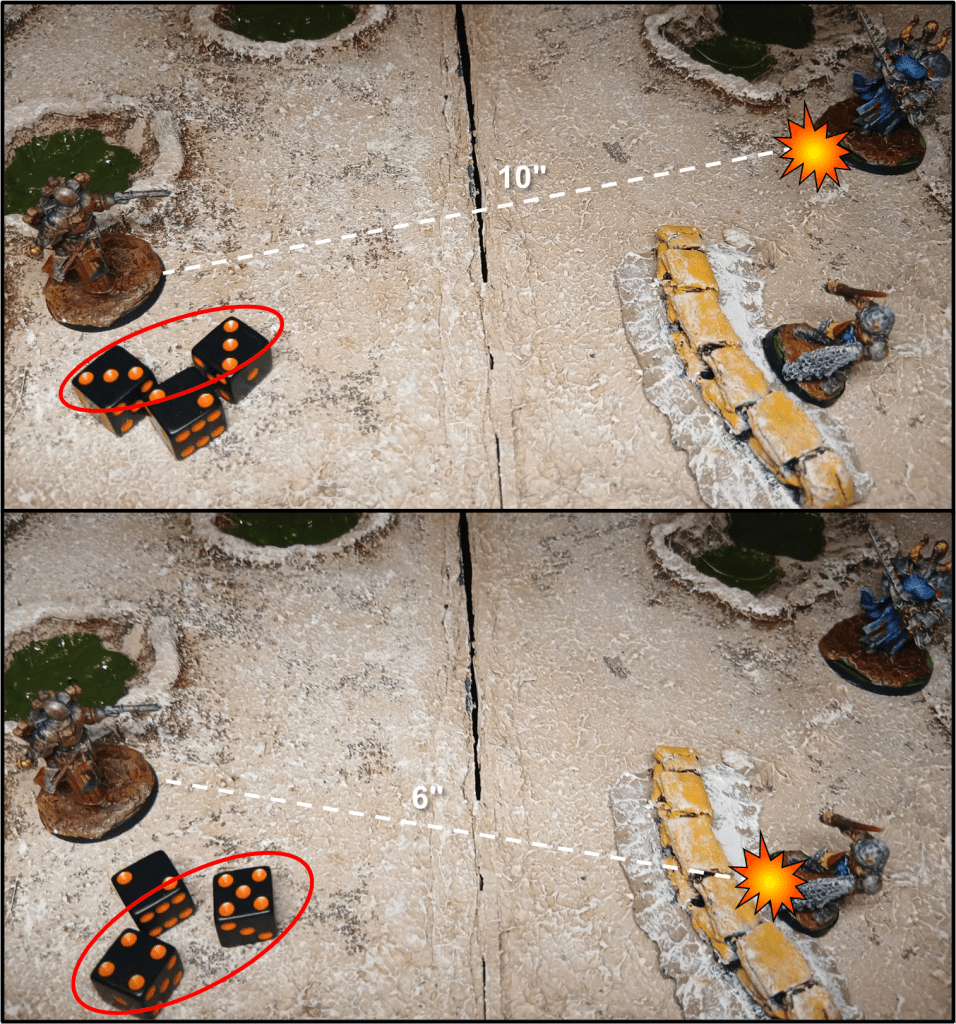
The second attack is directed against the Wretched. He is within half range, but as he is in Cover the attack still suffers a -1 DICE penalty. Yet again the total modifier is +2 -1 = +1 DICE. This time the two highest results add up to a 9 so a hit is scored, and the War Prophet proceeds to roll for injury.
BLOOD and BLESSING MARKERS: as with any other ACTION, the opponent can spend any number of BLOOD MARKERS from the attacking model to inflict a -1 DICE modifier to the Success Roll for each BLOOD MARKER spent.
On the other hand, the player controlling the attacking model can spend 1 or more BLESSING MARKER: each grants a +1 DICE modifier to the Success Roll.
Friendly Fire: Unless explicitly allowed to attack friendly models, a model can only choose an enemy as the target of a Ranged or Melee Attack. However some situations may arise in which a model is inadvertently hit by an attack made by a friendly model. The most common are the following:
- Area of Effect: Some attacks hit every model in an area, be it a sphere such as with BLAST weapons or a line, such as the Brazen Bull’s Flame Cannon. In this situation any model in the weapon’s BLAST area or path is hit, regardless of their affiliation.
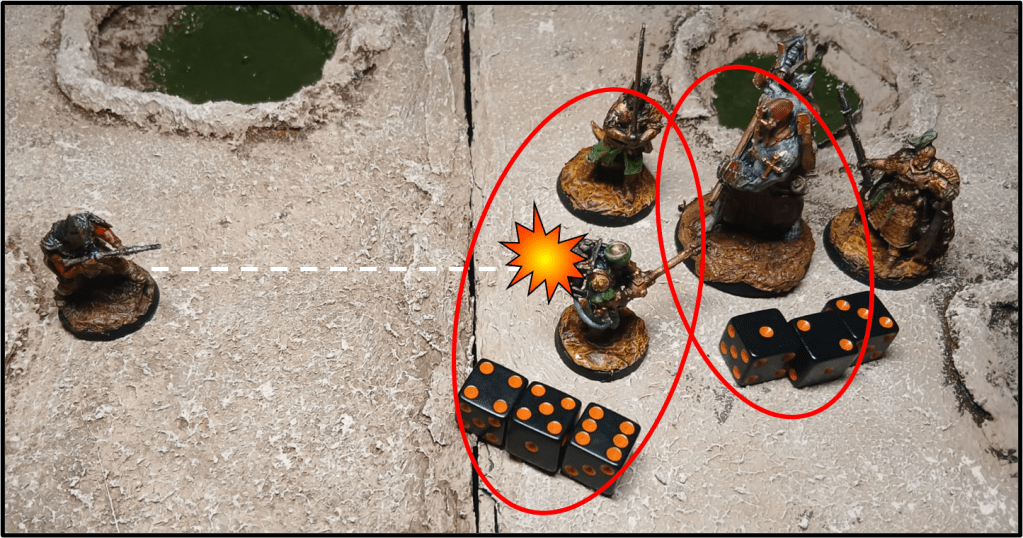
- Shooting into Melee Combat: When making a ranged attack, it is possible to choose an enemy engaged in Melee Combat as the target. However, since models in melee are constantly moving and shifting around, hitting the intended target is not guaranteed: When shooting in melee, after choosing a target but before rolling to hit, randomly assign each shot to models involved in the Melee Combat by rolling a d6 for each: on a 1-3 the shot must be directed at a friendly model involved in the melee while on a 4-6 the attacker can choose to attack an enemy model.
Note that whenever you have to make an Injury Roll for a model, regardless of the source of the injury, it’s always the opponent of the player controlling the model who gets to decide how to spend BLOOD MARKERS on the Injury roll, while any choice regarding the expenditure of BLESSING MARKER is made by the controller of the hit model.
Making a Ranged Attack
A Ranged Attack is any attack made at more than 1″ of distance, using a ranged weapon, such as a rifle shot, a machinegun burst or a grenade throw. Barring any special rules that may provide exceptions, a model:
- cannot make a Ranged Attack while within 1″ of an enemy;
- can only use a single weapon to make a Ranged Attack with during a Shoot ACTION
- cannot take a Charge or Fight ACTION in the same activation which it takes a Shoot ACTION (regardless of the order these ACTIONS are taken), unless any Ranged Attack made during the Shoot ACTION is made with a weapon with the keyword ASSAULT.
A Ranged Attack might be affected by the following (note that, unless specified, all +DICE/-DICE modifiers to the attack roll are cumulative):
Line of Sight: Trench Crusade uses a “true line of sight” approach: a model can only be targeted by a Ranged Attack if any of its parts can be seen from any part of the attacking model. It is assumed that models are constantly moving around so they are not constrained by the static poses of their miniatures. As Trench Crusade is not meant to be an ultra-competitive game, a bit of lenience and sportsmanship on both parts is advised here: the targeted area must be at least be part of the model itself: weapons extremities, ornaments and such could not be enough to properly target the model. Both models and terrain can block Line of Sight.
Long Range: If the target is wholly beyond half the maximum range of the weapon used for the attack, the success roll suffers a -1 DICE penalty.
Cover: If the target is visible, but is in Cover, the success roll suffers a -1 DICE penalty. In order to gain Cover a model must satisfy the following conditions.
- The model must be in contact with a terrain element;
- The terrain the model is in contact with must be at least 1/2” high and at least as wide as the model’s base;
- The terrain lies between the attacker and the target.
- The model is not completely visible from the attacker’s point-of-view.
A model is also considered in Cover if it has the COVER keyword, regardless of the validity of the above conditions.

Elevation: A model gains a +1 DICE modifier if it stands on a surface that is 3″ or higher than the surface the target is standing on (measured base-to-base).
FLAMETHROWER: Some weapons, such as Flamethrowers, and Corruption Belchers, work by saturating an area with gas or flammable liquids and automatically hit their target. When you make a Ranged Attack action with a weapon with the FLAMETHROWER keyword, you count the Success Roll as a success and proceed directly to the injury roll. Note that since you are not rolling to hit, the attack ignores any Cover or Long Range modifiers and can never result in a Critical Hit.
BLAST: Some weapons cause an explosion that can hit multiple target at once. When using a BLAST(X”) weapon, you can choose whether to target a model or a point on the battlefield.
When targeting a point on the battlefield, as no model is targeted, Cover modifiers do not apply, while the attack is affected by Long Range and Elevation unless the description says otherwise.
Regardless of the chosen target, you make a Success Roll to hit as normal: If you hit, all models, friend or foe, within a X” radius from the center of the BLAST are hit and suffer an injury roll. The center of the BLAST is the target point, or, in the case of targeting a model, the center of the target’s base. In addition, to ensure that the risk of shooting in melee with BLAST weapons is not taken lightly, models friendly to the attacker that are within 1” of an enemy hit by the BLAST are also hit, even if they are outside the BLAST range.
A model that cannot be seen from the center of the BLAST, for example because it’s behind a wall, is not hit by this attack. Make a separate Injury Roll for each model hit. On a Critical Hit, the additional +DICE to the injury roll only applies to the model in the center of the BLAST, if any.
As per normal ranged attack rules, if an attack with BLAST(X) misses, it will have no effect whatsoever. The grenade or shell is a dud, or it lands off-target without doing any real harm, that is unless the attack also has the SCATTER Keyword.
SCATTER: If an attack with SCATTER misses, the landing point is moved, along a direction chosen by the opponent, a number of inches equal to the “degree of failure” (i.e. 7 – the result of the roll to hit). For example if the Success Roll results in a 5, the detonation point will deviate 7 – 5 = 2″ away from the declared spot. Resolve the effects of the attack counting the new position (a point either on the battlefield, on a terrain element or on a model’s base) as the center of the BLAST(X”).
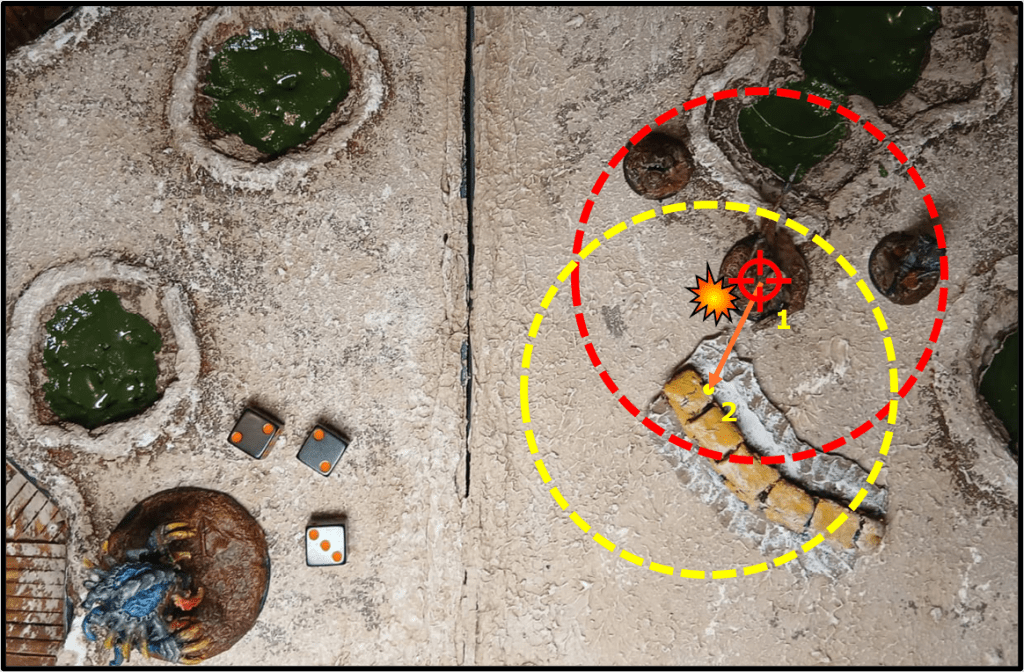
AUTOMATIC: When using a weapon with the AUTOMATIC(X) keyword, a model can perform X Ranged ATTACKS with a single Shoot ACTION. Each attack is resolved independently: you choose a target, check distance and make a separate Success Roll and, if necessary, Injury Roll, for each Ranged Attack made, then immediately proceed to resolve the next attack. Unless otherwise specified, all the targets of attacks from an AUTOMATIC weapon must be within 6″ of one another.
Note that each attack is separate, which means that effects that influence a single Success Roll or Injury Roll such as the -1 DICE inflicted by spending BLOOD MARKERS or powers like Charm of Acedia only affect a single roll and not the Shoot ACTION as a whole. For the same reason, BLOOD MARKERS inflicted by the first attack, can be spent to add +INJURY DICE on the second attack, if it hits.
IGNORE [MODIFIER]: Finally, several weapons have the possibility to ignore one or more modifiers to the Success Roll, depending on the Keywords they possess. The most common are IGNORE COVER and IGNORE LONG RANGE, that allow the attacker to ignore the negative modifiers, but some weapons have IGNORE ELEVATION, therefore they won’t be able to benefit from the +1 DICE bonus in that situation.
The Fight ACTION
Models in Melee Combat can make Fight ACTIONS against enemies they are engaged with in order to make Melee Attacks. Melee Attacks are resolved according to the general rules described above, with the following differences.
- A model cannot make a Melee Attack unless it is within 1″ of an enemy.
- The number of Melee Attacks a model can make during an activation is limited by the number of melee weapons it can wield at a given time: even if some situations can allow a model to carry more weapons, it can only use a single two-handed melee weapon or up to two one-handed melee weapons (one of which as Off-Hand) to attack. Models with more than two arms are subject to different rules which will be detailed in their description.
- If a model armed with two one-handed Melee Weapons takes a Fight ACTION, it can make a Melee Attack with each weapon, if it has hands available to use it. These attacks are resolved independently, one after the other, and can be directed against the same enemy or at different targets. The model can use the weapons in any order, and the second weapon used will suffer the Off-Hand penalty to the Success Roll (-1 DICE).
- A model that is not equipped with any Melee Weapon cannot attack in Melee unless it has a rule that allows it to attack unarmed.

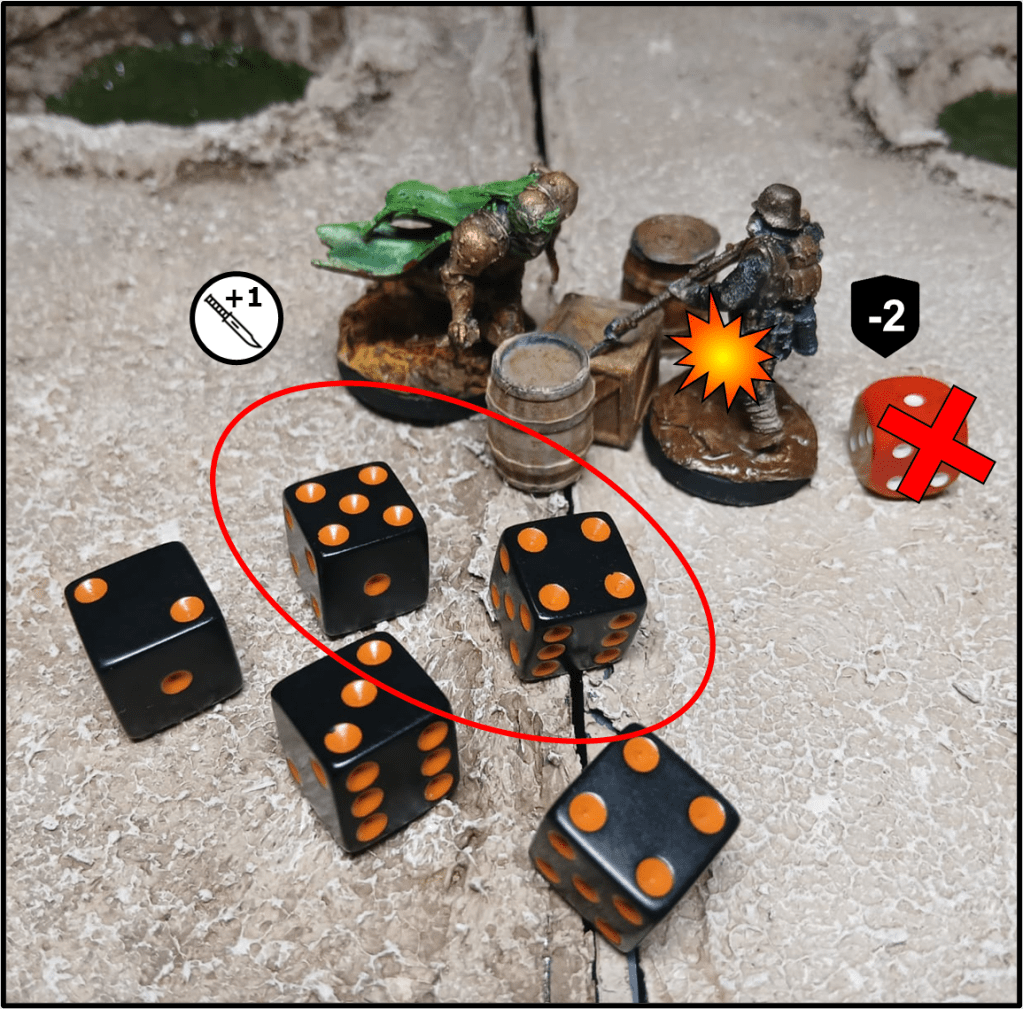
Note that the BLOOD MARKER on the Heretic Trooper cannot be used to influence the Assassin’s success roll, but it can be used on the subsequent injury roll (see also Figure 6 below)
When making a Melee Attack, the following modifiers apply:
Defended Obstacle: A model that makes a Melee Attacks against an enemy in Cover (see above) suffers a -1 DICE penalty to the Success Roll.
Diving Charge: A model that makes a successful Diving Charge (see our previous article about movement for a description of the rules) gains a +1 DICE modifier to the first Success Roll it takes for a Melee Attack in the same activation it charged.
Off-Hand Weapon: A model carrying two one-handed melee weapons can make two Melee Attacks with a single Fight ACTION. The weapon used for the second attack must be used as an Off-hand weapon and will suffer a -1 DICE penalty to the Success Roll.
The following Keywords affect Melee Attacks and their Success Rolls:
BLOCK: A model armed with a weapon with the BLOCK keyword (such as a Polearm) inflicts a -1 DICE penalty to the Success Roll roll of enemies who make a Melee Attack against it in an activation in which they charged.
CLEAVE X: A weapon with CLEAVE X allows a model to make X Melee Attacks any time the model takes a Fight ACTION. These attacks must be made right one after the other and can be made against the same target or can be split against multiple enemies. If the weapon with CLEAVE is used as an Off-Hand Weapon, all Melee Attacks made with it will suffer the Off-Hand Weapon penalty.
FEAR: A model that makes a Melee Attack ACTION suffers a -1 DICE penalty if the target of the attack has the keyword FEAR. A model with the keyword FEAR is itself immune to FEAR and will not suffer this penalty.
PISTOL: Although they are Ranged Weapons, weapons with the PISTOL keyword can be used in Melee Combat following the normal rules for a Melee Attack (including the possibility to be used as Off-hand weapons, with the associated penalty), with the exception that they attack using either the Melee or the Ranged Characteristic of the attacking model (as chosen by the player making the attack).
IGNORE [MODIFIER]: Just like Ranged Attacks, Melee Attacks can also benefit from keywords that allow them to ignore modifiers to the Success Roll, such as IGNORE COVER or IGNORE OFF-HAND WEAPON.
The Injury Roll
When a model is hit by an attack, the attacker makes an Injury Roll to see what happens to them.
Normally this is done by rolling 2d6 and adding the results together, applying specific modifiers due to the attacker’s weapon, target’s armour and shield, and any other Battlekit or abilities possessed by either model.
- +/- INJURY DICE are added to the dice pool rolled, before rolling, in the same way +/- DICE affect a Success Roll. (note that +/- INJURY DICE cannot be applied to affect a Success Roll, while +/- DICE do not affect Injury Rolls)
- +/- INJURY MODIFIERS are counted after the roll, adding or subtracting the modifier’s value to the final result of the Injury Roll.
Based on the final result after all modifiers have been applied, one of four possible outcomes can happen:
- 1 or less: No effect. The attack bounces off the target’s armour and inflicts no significant harm.
- 2-6: Minor hit. The target suffers 1 BLOOD MARKER.
- 7-8: Warrior Down! The target suffers 1 BLOOD MARKER and is marked as Down. A model that was already Down when suffering this result receives an additional BLOOD MARKER (for a total of 2). While Down, a model:
- cannot be moved in any capacity;
- suffers a -1 DICE penalty to all Success Rolls and Risky Success Rolls it takes;
- suffers all further Injury Rolls in Melee with +1 INJURY DICE .
- 9+: Out of Action. The model is removed from play.
There are several ways to affect an injury roll.
Critical Hits: A result of 12+ on the roll to hit is a critical hit, and it applies +1 INJURY DICE to the subsequent roll to injure the target. If the attack is from a weapon with the keyword CRITICAL, then this becomes +2 INJURY DICE instead.
Weapon modifiers: Several weapons apply a modifier to injury rolls they cause. Weak attacks might call for a -1 INJURY DICE modifier while more powerful attacks can have a +1 INJURY DICE or even +2 INJURY DICE or more. Some weapons apply a +1 or +2 INJURY MODIFIER to the final score. Finally, some extremely deadly weapons, such as the Catherine Wheel wielded by an Anchorite Shrine have the DEADLY Keyword, which allows the attacker to roll 3d6 instead of 2d6 on the injury roll, adding the scores together.
Remember that when an effect allows you to roll a different amount of Injury Dice than 2 in the base pool, you’ll have to use the modified number of D6s as the base for applying +/- INJURY DICE modifiers. For example, if an attack from a Catherine Wheel is modified by spending 2 Blood Markers for +2 INJURY DICE, the final injury roll would be of 5d6 (base of 3 due to DEADLY, +2 INJURY DICE), with sum of the 3 higher dice compared against the Injury Chart.
Armour and Shields: Armour and Shields worn by a model apply a -INJURY MODIFIER to any injury roll it suffers.
- Trench Shield: -1 INJURY MODIFIER
- Standard Armour: -1 INJURY MODIFIER (can be combined with a Trench Shield for -2 total)
- Reinforced Armour: -2 INJURY MODIFIER (can be combined with a Trench Shield for -3 total)
- Machine Armour: -3 INJURY MODIFIER (cannot be combined with a Trench Shield)
Some particularly resilient models may have an intrinsic armour value. The rules will dictate how much protection it will provide, and whether it can be combined with a shield or not. The maximum -INJURY MODIFIER a model can have cannot be more than -3.
Some attacks are made with the ARMOUR-PIERCING or IGNORE ARMOUR keyword: ARMOUR-PIERCING will reduce the overall -INJURY MODIFIER from the target’s Armour or Shield by 1, while IGNORE ARMOUR will completely negate the protection provided by armour and shields, ignoring any -INJURY DICE and -INJURY MODIFIERS keywords those items have. This only applies to these keywords: other effects that the armour grants, such as the ability to convert Down results into Minor Hits of a Mechanized Armour, won’t be affected.
In addition, some special types of armour, such as the Holy Icon Armour, Holy Icon Shields and Infernal Iron Armour, have the IMPERVIOUS keyword: their -INJURY DICE or -INJURY MODIFIER keywords always apply regardless of the ARMOUR-PIERCING or IGNORE ARMOUR the attack may possess.
BLOOD and BLESSING MARKERS: BLOOD MARKERS and BLESSING MARKERS on the target of an attack can affect an injury roll on that model in three distinct ways. Remember that it’s always the opponent who chooses how to spend BLOOD MARKERS on a model, while the use of BLESSING MARKERS is decided by that model’s controller.
- By spending BLOOD MARKERS, the opponent can add +1 INJURY DICE to the injury roll for each BLOOD MARKER spent.
- BLESSING MARKERS can be used by the player controlling the model suffering the injury, applying -1 INJURY DICE to the injury roll for each Marker spent.
- By spending 6 BLOOD MARKERS (or 3, if the target is Down), the attacking model can turn an Injury Roll to a Bloodbath Roll. This allows the model to make the roll with 3d6 instead of the usual 2d6 (modified by +/- INJURY DICE as discussed above), summing the results together. On a DEADLY attack, a Bloodbath roll is made with 4d6.
Note that in order to execute a Bloodbath on a model, all BLOOD MARKERS must come from that model. INFECTION MARKERS inflicted by some models and equipment of the Black Grail can be used to cause a Bloodbath as well (as they can be spent with the same effects BLOOD MARKERS have) and it is possible to cause a Bloodbath by combining BLOOD and INFECTION MARKERS together.
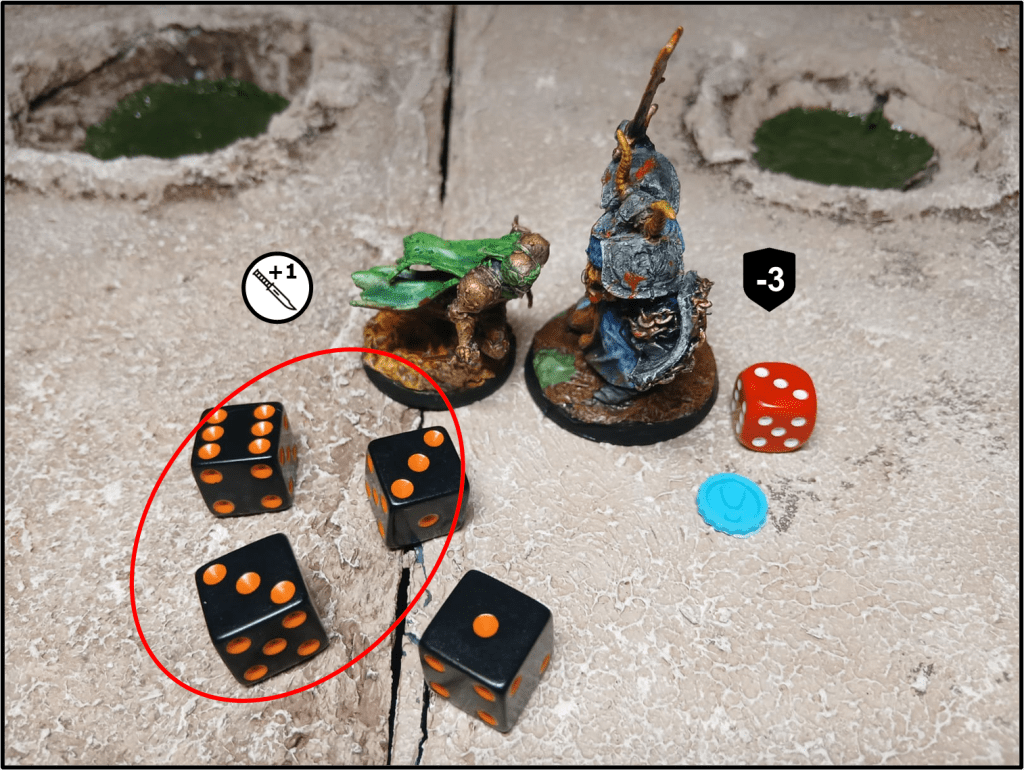
Attacking a Downed Model: Melee attacks against models who are Down are resolved with +1 INJURY DICE (remember: only Melee Attacks receive this modifier. Injury Rolls from ranged attacks or other effects do not). In addition a Downed model that suffers a Down result again will take one additional BLOOD MARKER from that attack (for a total of 2 BLOOD MARKERS).
Resistance to Injuries: Due to innate resilience or special equipment, some models are more difficult to harm by attacks of a given type, such as FIRE or GAS, or Melee Attacks, or even by all kinds of attacks. These models benefit from a -1 INJURY DICE (or, more rarely, -2 INJURY DICE) modifier to injury rolls against attacks of the listed types. Some notable examples:
- Due to their inhuman anatomy, Takwin Creatures built by Jabirean Alchemists, such as Lions of Jabir or Brazen Bulls, have an innate -1 INJURY DICE penalty to all injury rolls they suffer.
- Likewise, Martyr Penitents are sustained by the mysterious power of the Seventh Meta-Christ and they have an innate -1 INJURY DICE to all injury rolls they suffer as well.
- Most creatures created by the Black Grail are undead monstrosities that feel no pain. They apply a -1 INJURY DICE modifier to all injury rolls they suffer, unless the injury is caused by a weapon with the FIRE keyword. An Amalgam is even more resilient, applying a -2 INJURY DICE penalty to all injuries (including those caused by FIRE!).
Finally, we take a quick look at some additional effects that often come into play when injury rolls are involved, and while don’t affect the roll itself, will alter its outcome, often in a significant way. Almost all of these are managed via keywords, so we’ll just hint at them here. Don’t worry, we’ll take a deeper look in a future article.
FIRE, GAS and SHRAPNEL: Weapons with the keyword FIRE, GAS or SHRAPNEL inflict one extra BLOOD MARKER to a model hit by these kinds of attack in addition to any other effect the injury caused (including an outcome of “No Effect”). This additional BLOOD MARKER is assigned after the injury roll is made, so it cannot be spent immediately to affect the outcome of the roll.
“Injury Replacement” Effects: some effects or abilities replace the outcome of an injury roll with another outcome, usually less severe. For example a Machine Armour grants the wielder to replace any Down result suffered into a Minor Hit. The most powerful replacement effects, of course, are those who prevent a model from going Out of Action: GOLEM and TOUGH (who turn an Out of Action result in a Down) and the War Prophet’s Memento Mori, who completely disregards the first attack who would take the model Out of Action.
And that’s it. Whoa, was that long, but at least now we have all the basics we need to know in order to play. Next time we’ll take a look in detail at the keywords and how they affect gameplay. See you soon!



Leave a Reply