ARTICLE BASED ON THE v1.6 PLAYTEST RULES – SEE THE UPDATED VERSION HERE
And here we are, back again! Our journey through the rules of Trench Crusade continues; last time we saw how models activate and how they can perform ACTIONS during the game. Today we’ll take a more in-depth look at what would likely be the most common ACTIONS your models will take in the game: Move and Dash.
Disclaimer: This article has been written using as a reference the current version of the Playtest rules (v1.6) available for download on the Trench Crusade website. While I don’t expect significant changes in the core rules when the final rulebook goes live, I’m aware there could be some changes. I’ll try to keep everything as up-to-date as possible to avoid providing obsolete information.
Each models has a Movement characteristic in its profile, that is shown as X”/Type.
- X” (commonly 6″) is the “basic” movement value of the model, i.e. the number of inches a model can normally move during a Move ACTION. This can be modified by various game situations as we’ll see below, for example charging, standing up after being down or crossing difficult terrain.
- Type is the movement type the model has access to, which can be either Infantry or Flying. Infantry models follow all the rules shown below. Specific exceptions for Flying models will be noted. When no such exceptions are listed, then the rules apply to both Infantry and Flying models in the same way.
The Move ACTION
The Move ACTION is one of the common ACTIONS available to all models. Whenever it performs a Move ACTION, your model has the possibility to execute one (and only one) of the following:
- Standard Move: Move up to its Movement value. May neither enter nor leave Melee Combat (*).
- Charge: Move up to its Movement value +D6 and enter Melee Combat.
- Retreat: Move up to its Movement value. May leave Melee Combat, but the enemies it is in Melee with may execute a free Melee Attack against it.
(*) Two enemy models are in Melee Combat whenever they are within 1″ of one another.
As with any other ACTION, a model can only perform a single Move ACTION per activation, so it cannot, for example, do a Standard Move and then Charge, or Charge and then Retreat in he same turn.
The Move ACTION is an exception to the standard rules as it does not require a roll on the Action Success Chart to be performed. Note that because of this, any effect that causes ACTIONS to become RISKY (such as the Herald of Beelzebub’s Maddening Buzz or the Shaken condition obtained when failing a Morale Test) does not affect Move ACTIONS, as you won’t need to roll so you can never fail to execute the ACTION.
Regardless of the options, there are a set of general rules that always apply when moving. Unless another rule says otherwise, a model that takes a Move ACTION:
- cannot enter Melee Combat (i.e. move within 1″ of an enemy) unless it is charging;
- cannot leave Melee Combat unless it is retreating;
- cannot voluntarily leave the battlefield;
- can move through friendly models. as long as it is able to clear them completely.
Note that the explicit reference to the possibility to move through friendly models implies that it is forbidden to move through enemies or “neutral” models.
With these restrictions in in mind, let’s see how the three types of movement work:
Standard Move: When performing a Standard Move, a model may move a number of inches in any direction up to its Movement value. This can be split into parts, as long as the overall movement does not exceed the Movement value of the model, so your model can move around obstacles and up and down vertical surfaces (more on vertical movement later).
When moving, a model can pass through friendly models as if they weren’t on the battlefield, but must end the move in a position where its base doesn’t overlap any models’ bases. This applies to any kind of movement, not just Standard Moves. Models performing a Standard Move cannot, however, come within 1″ of any enemy models at any point during their move, unless they began their activation already within 1″ of those models.
Moving while in Melee Combat: A model that starts its activation in Melee Combat is allowed to make a Standard Move ACTION, this is usually done to move around an obstacle that would inflict a penalty to Melee Attack ACTIONS, or to get within range of an objective to contest it or claim it. This move however must end so that the model is still in Melee Combat with any enemy it was in Melee with at the start of the activation and, since it is not a Charge, it cannot be used to enter in Melee Combat with other models.
Charge: A Charge move is the most common way a model can enter Melee Combat with an enemy. The process for executing a Charge is the following:
- Select one enemy model within 12″ of the active model as the target of the Charge.
- If the target is not visible from the point of view of the charging model, then the Charge becomes a RISKY ACTION. Roll on the Action Success Chart now, and proceed only if the roll succeeds (ignore this step if the target is visible, even partially).
- Roll a D6 and add it to the charging model’s Movement characteristic to determine the Charge distance, up to a maximum of 12″.
- Move the model along the shortest and most effective route (i.e. in a straight line, when possible) that allows it to get within 1″ of the target.
- Charges are affected by terrain as normal, so they are slowed down by Difficult Terrain, and may involve any vertical movement if needed.
- If this route forces the charging model to Climb, Jump or move through Dangerous Terrain, the model has the option to follow an alternate route. This however must still be the shortest possible.
- If a Downed model stands up at the start of its activation, all movement it makes during that activation is halved. When charging, this includes both the basic movement and the D6 roll.
- If the model is not able to get in Melee Combat with the target, the Charge is considered failed, but the full charge distance must nevertheless be moved.
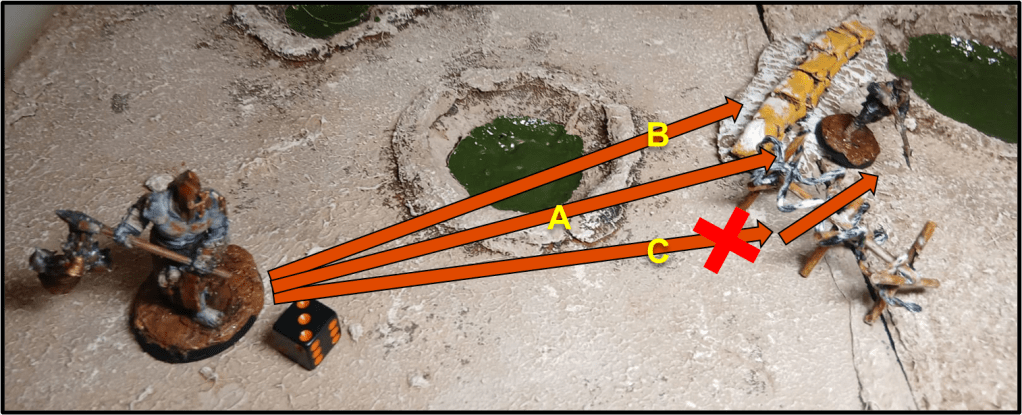

House of Wisdom [Confirmed]: As soon as the model gets into Melee Combat with the target, it can stop at any point within 1" of it. it doesn't need to get into base-to-base contact.
The rules above refer to a model charging a single enemy. A model can also attempt to charge multiple enemies at once, if there is a place within 12″ that it can reach from which it is in Melee Combat with all the target models. As per current rulebook (v1.6) the rules for charging multiple enemies lack a few details so some interpretations, which may note be 100% correct, are needed:
- It is not perfectly clear how “shortest and most effective route” has to be drawn. My interpretation is that the charging model has to move directly towards a point where it can be in melee with all the targets of the charge, and if no such point exists, or if it is inaccessible, the charge cannot be declared.
- If at least one targets is not visible to the charging model, then the whole charge becomes a RISKY ACTION.
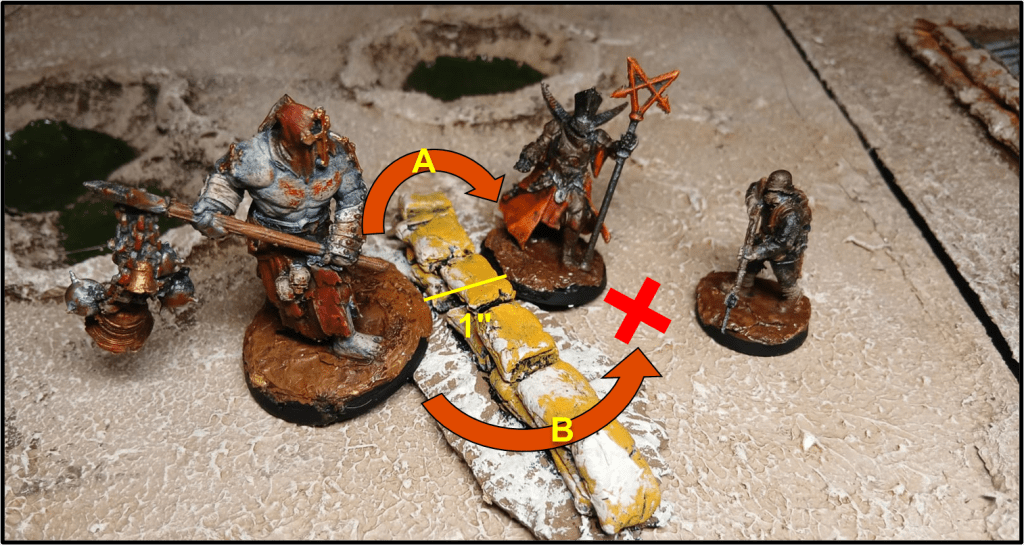
When a model charges, it can pass within 1″ of enemy models. However if any of those models is not the target of the charge, the charge is intercepted and the model must stop in Melee Combat with the interposing enemy. This can be exploited by savvy players to protect models that are weak in Melee or in critical positions, for example in the proximity of objectives.
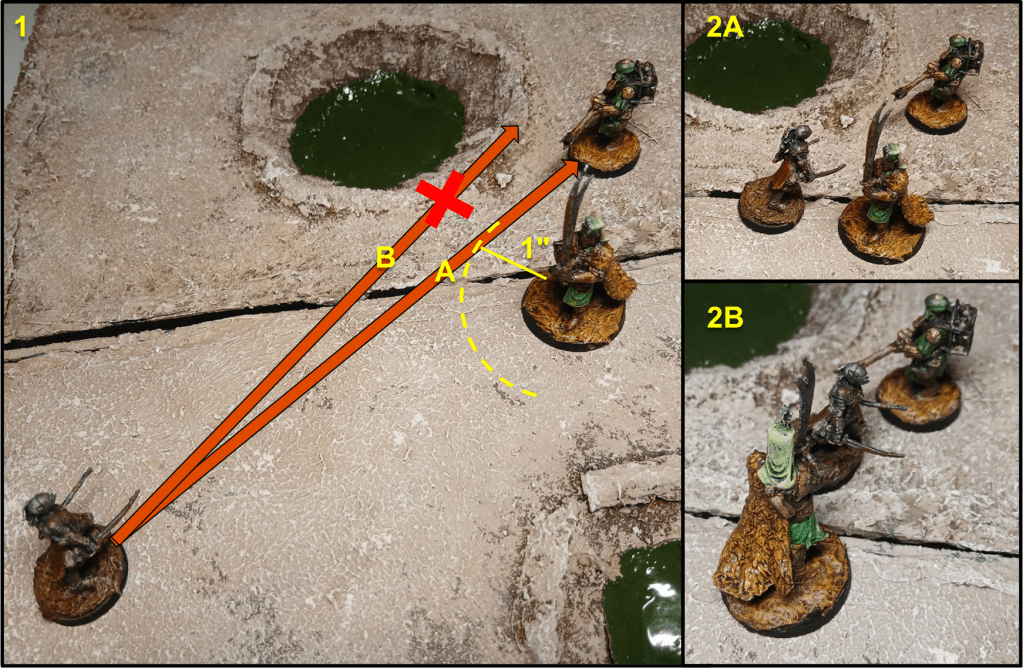
Had the Nun decided to declare a charge toward both enemies, she would have been able to go past through the 1″ interception range of the Janissary and get into melee combat with both enemies (2B).
Retreat: A model in Melee Combat has two options: as we have seen above it may take the Standard Move action and move while staying engaged in Melee. If it wants to leave combat, however, the model has to use its Move ACTION to Retreat.
A Retreat is functionally identical to a Standard Move, but it allows a model to disengage from Melee Combat. The disadvantage is that any enemy it is in Melee Combat with can make a single Melee Attack ACTION for free against the retreating model before it has a chance to move.

House of Wisdom [To be confirmed]: A retreating model that gets taken Down by this free attack must stop moving (as it cannot move due to being Down). It may take a RISKY ACTION to immediately stand up but it won't be able to Retreat again in the same activation: the RISKY ACTION to stand up happened after the Retreat ACTION so the latter cannot bee taken again
Special Movement Effects
Some abilities and effects allow models to move in unusual ways, or to move outside their own activation. While each effect is unique and there are no hard and fast rules to cover them all, some common characteristics of these movements may be identified. That said, I would advise you to read each effect’s description carefully, and check the House of Wisdom page to see if any clarification has been given.
Movement granted by abilities: Some special effects, abilities and attacks allow a model to move or to be moved outside its own activation. The description of each of those effects will usually tell whether they will allow a model to enter or leave Melee Combat, and, in the latter case whether the enemy is granted a free melee attack or not. As a general, rule-of-thumb, unless otherwise stated:
- Any effect that allows a model to move away from Melee Combat on its own grants the enemy a free attack only when it is explicitly stated it counts as a Retreat (such as Puppet Master) as the attack is only normally granted in that situation. Thus effects like the knockback from the Infernal Bomb of Artillery Witch or the free movement granted by the Tartarus Claw don’t allow an enemy model to make a free attack.
- Movement effects and abilities can cause a model to enter Melee Combat even if they did not declared a charge. The ability will specify whether the model counts as charging if it enters Melee this way (this can be important for certain effects, such as the defensive ability of Polearms).
Teleportation Effects: Some abilities and equipment allow models to be “placed” directly in a determined spot, usually within a certain range of its previous position. Such effects, which I would call “Teleportation effects” for a lack of a precise game term, follow a few common principles that, even if not explicitly stated in the rules, pretty much every player can agree upon
- A teleporting model is removed from its position on the battlefield and is immediately placed in a different position, without properly moving across any terrain in-between. This allows the model to ignore the effects of Difficult, Dangerous and Impassable terrain and to climb or jump without the need of an ACTON.
- A teleporting model that leaves Melee Combat (if the ability allows it) does not cause any free attack from the models in Melee with it.
The Dash ACTION
The second movement option available to (almost) every model in the game is the Dash ACTION. This is a RISKY ACTION that, if successful, allows the model to execute a Standard Move. That’s it. No huge shenanigans. Pass the roll, you move. Next topic!
Well… to be fair in all its simplicity, Dash brings a lot to the table and is a critical – if not the most critical – part of a warband’s arsenal.
Being a different ACTION, it bypasses the rule that prevents a model to take the same ACTION more than once per activation. This offers several tactical advantages:
- It allows models to get in attack range more quickly, thus enabling more attacks during the course of the game;
- It allows faster movement towards objectives;
- It allows models to stay safe behind line of sight-blocking terrain, pop out for a ranged attack and dash back to safety (the so called “peek-a-boo attacks”).
The limitations posed by Dash being a RISKY ACTION make it so that the game doesn’t devolve into a big melee in the center or a standoff with both warbands hidden and nobody able to get a shot at the enemy: in order to take a long-range charge you’ll need to Dash first, potentially wasting a model’s turn completely, while for peek-a-boo shooting you need to choose: do you want to take a Dash first, risking not to shoot at all but staying in a safe spot in case things go wrong, or do you prefer to have the certainty to make an attack, but risking to keep your model stuck out in the open? The fact that there is no easy answer that is valid in every situation is an example of how a small design decision can provide a lot of tactical depth, at least to me.
With Dash being a crucial part of a warband’s strategy, anything that makes it easier cannot be underestimated. Each faction has at least one model that benefits to +DICE to Dash ACTIONS, either intrinsically or through upgrades:
- Heretic Legions: War Wolves, all models in Heretic Naval Raiding Party warbands.
- Trench Pilgrims: Ecclesiastic Prisoners, Stigmatic Nuns, Anchorite Shrines with Holy Diesel Engine (St. Methodius).
- Iron Sultanate: Lions of Jabir, Assassin with Thunderbolt of Alamut (Fida’i of Alamut), Homunculus with Startling Speed (House of Wisdom).
- New Antioch: Lieutenant and Shocktropers with Rapid Assault (Prussia).
- Black Grail: Hounds of the Black Grail, Cup of Filth.
- Court of the Seven-Headed Serpent: Desecrated Saint (Wrath), models with Blind Rage (Wrath).
Every warband has also access to Musical Instruments and, in campaign, the Sprinter skill in the Stealth & Speed skill table. And don’t forget you can use BLESSING MARKERS to grant +DICE to any ACTION, including Dash, but be always aware that the opponent can – and will often do – use BLOOD MARKERS on your model to hinder your Dashes and other RISKY ACTION and put a spanner in your works.
Climbing and Jumping
Trench Crusade is at its best when the three-dimensional aspect of the battlefield is at the forefront. Trenches, buildings and other structures not only provide a beautiful scenery and objectives to conquest and defend, but also affect the game rules in a significant way, blocking lines of fire and altering the movement of models.
All movement in Tench Crusade is counted in any direction, including vertical. When a model moves, you measure the effective movement along any surface it moves across. Ramps, stairs, shallow craters and such are considered open terrain and models can freely move and stand over them.
Climbing: When it comes to steep surfaces like walls and ladders, models can move up or down by counting the vertical distance as part of their normal movement. This includes Charges, Retreats and Dashes, with the restriction that the model must be able to clear the entire height in a single ACTION.
If the surface has footholds or other aids meant for climbing, like a ladder or a rope, climbing up or down the surface is automatic. This includes trench walls, as it is assumed that there’s plenty of supports and climbing aids. When a model needs to climb up or down a sheer surface, like a wall, that doesn’t offer any footholds, it must first pass a Climb ACTION. Move the model in contact with the surface and take a RISKY ACTION. If the action succeeds, the model can continue its movement and climb, otherwise it ends its activation adjacent to the wall.

Flying models can climb up or down any surface without the need to take a RISKY ACTION (measure any vertical movement as usual).
Obstacles up to 1″ high can be crossed for free without the need of any ACTION and never count towards the model’s movement.
Jumping: As part of its movement, a model can jump across a horizontal gap wide up to half its movement characteristic by passing a RISKY ACTION. On a failure, the model falls and it is placed on either side of the gap, as chosen by the opponent.
A model can also jump to a ledge that is up to 1″ higher than it’s level following the same rules as above. If the height difference is at least 1/2″, the jump costs 1″ more of movement to make.
Flying models can jump across a gap wide up to their full movement characteristic without the need to take a RISKY ACTION.
Jumping Down: A model can voluntarily jump down a ledge of any height as a part of a move without spending any movement. If the level difference is 3″ or less, the model suffers no ill effects, otherwise this counts as a fall and the model may be injured.
Jumping across a gap towards a ledge at a lower level follows the same rules as a vertical jump down, once the model has managed to clear the gap with the RISKY ACTION.
Flying models can jump down from any height without the risk of getting injured.
Falling: a model might fall from an elevated position for several reasons
- It jumps down from a height of more than 3″
- It fails a RISKY ACTION to jump across a gap.
- It goes Down while within 1″ of a ledge. In this situation the model may take an ACTION roll to avoid falling (note that the model will first go Down, which will apply a -1 DICE penalty to the ACTION).
- It is pushed over a ledge by the effect of an ability or an attack, such as the detonation of an Artillery Witch’s Infernal Bomb.
A model that falls by more than 2″ (or 3″ if it jumped down voluntarily) must roll on the Injury Chart and suffer the resultant injury. This roll incurs in a +1 DICE modifier for each full 3″ the model has fallen. Armour applies as usual.
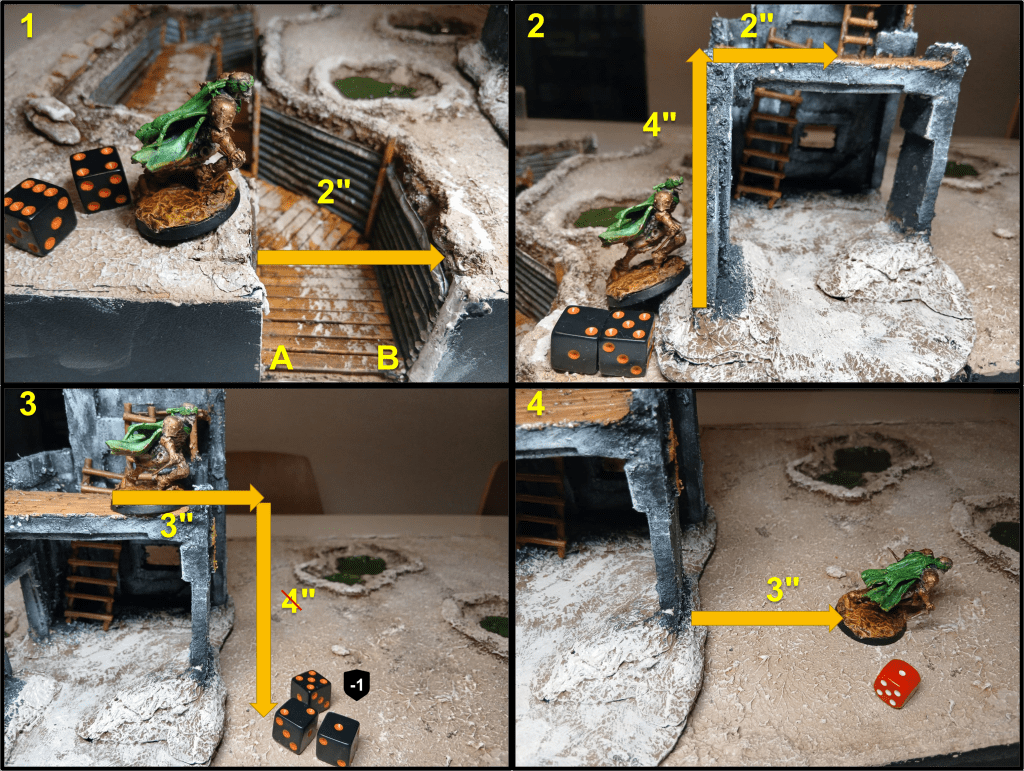
1) The Assassin (movement 6″) takes a Move ACTION, getting to the edge of the Trench and attempting to jump across it. The gap is 2″ wide (les than half its movement value) so the Assassin can take a RISKY ACTION (which succeeds) to move on the other side, and continue its advance towards the building. Had it failed, it would have fallen either in position A or B, as chosen by the opponent.
2) Now the Assassin successfully takes a Dash ACTION (roll not shown) and wants to climb on top of the 4″ high building. This requires another RISKY ACTION, which is successful, so the Assassin can move up by 4″ and use the remaining 2″ of movement to proceed ahead.
3) In the next turn the Assassin wants to return to the ground level, it could choose to take a RISKY ACTION to climb down, but it’s too slow for its needs and, on a failure, it would be forced to remain on the top of the building, so it decides to jump down. This way the vertical distance fallen is not counted; However, as the fall is more than 3″ in height, an Injury Roll is necessary. This suffers a +1 DICE modifier (fall of 3″ or more, but less than 6″). The player rolls a 7, -1 for the Standard Armour the Assassin is wearing makes it a 6: Minor Hit!
4) Having survived the fall with just a BLOOD MARKER, the Assassin is free to continue moving forward. It has already moved 3″ before jumping down, and the vertical 4″ dropped don’t count, so it can move 3″ more this ACTION.
Diving Charges: a charging model may exploit elevation to perform a risky but effective (and to be honest, pretty cool) maneuver called a Diving Charge. This might sound a bit complicated but really it’s not, trust the Troll.
First of all, you need to satisfy the following conditions:
- The charging model must jump down a ledge as a part of the charge.
- The target must be on a surface at least 3″ below the charging model when they jump down.
- The charging model cannot jump down more than 6″ this way.
- The landing point of the charging model must be within 2″ of the target.
If all these conditions are satisfied, a Diving Charge may be declared, and is resolved as following:
- Move the model so that it comes within 1″ of the target (effectively gaining 1″ of charging movement for free)
- Take a RISKY ACTION:
- If the ACTION is failed, the model is Down, and it suffers an injury roll as per the rules of Falling described above, thus incurring in a +1 DICE modifier per 3″ fallen, plus an additional+1 DICE due to being Down. Moreover the model has already been moved into Melee combat before taking the RISKY ACTION so if it somehow survives it will be Down and at the mercy of their enemy.
- If it’s successful, not only the model has avoided the damage caused by a 3″+ fall, but it will gain +1 DICE to all attack rolls and all injury rolls against the target of the charge and will ignore any Defend Obstacle penalties for the rest of it’s activation.

Flying… nope. Flying models won’t get any advantage when performing a Diving Charge, they’ll follow the normal rules and risk getting squashed like any other model.
Downed Models and Movement
We’ll take a deeper look at injuries in a future article but we can’t pass over the Down status too much, as it heavily interacts with movement.
A Downed model cannot move in its activation through its own ACTIONS.
This means that:
- A Downed model can move through another model’s ACTIONS (for example the Heretic Priest’s Puppet Master ability).
- A Downed model can move in another model’s activation (for example a Sultanate Assassin can use its Time Slip ability even when down).
It is unclear at this stage whether teleportation effects like the Goetic Power Coveted Position counts as a Move and whether it can be used by a downed model. Keep following the House of Wisdom page for updates.
If a Downed models stands up at the beginning of its activation, all movement it takes during the same activation is halved (during a Charge, this includes both the base movement and the D6 roll). This limitation doesn’t apply either when the model goes Down in its own activation and stands up immediately by passing a RISKY ACTION, nor when the model is made to stand up by the ability of another model (such as a Castigator’s Enforced Orthodoxy) or equipment (i.e. a Medi-Kit).
Terrain and Movement
Terrain elements in Trench Crusade affect many aspects of the game, such as movement, line of sight and the accuracy of attacks. We have already seen above how the three-dimensional aspects of terrain come into play and interact with movement. In addition, a terrain surface can be classified as one of the following:
- Open: This has no impact on how models move. The majority of flat or low-sloping surfaces, both at ground level or the floors of buildings, are open terrain. Low obstacle, up to 1″ in height, are considered open terrain as well.
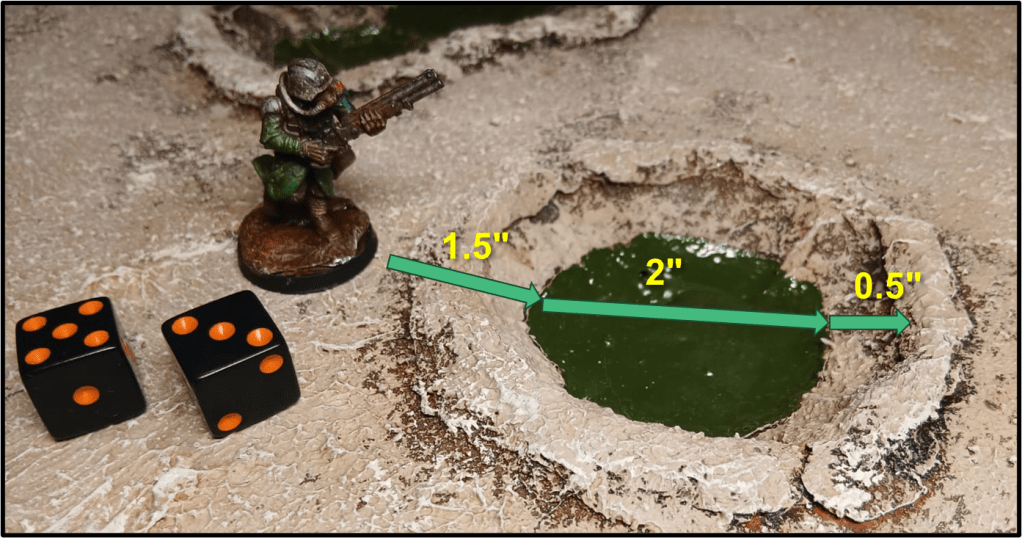
- Difficult: denotes terrain that is hard to move across due to obstacles, debris, narrow spaces and such. All movement through Difficult Terrain costs double so each 1″ effectively moved counts as 2″ of movement instead.
- Impassable: solid terrain like large boulders and walls, or deep pits/chasms cannot normally be moved through. Depending on the nature of the terrain element, they can be climbed or jumped across however.
In addition, any of the above may also be classified as Dangerous Terrain:
- Dangerous: Terrain elements such as barb wire, minefields, areas covered in fire or poison gas are considered Dangerous. When a model starts its activation or enters Dangerous Terrain, it must immediately take an ACTION (which is a RISKY ACTION if the model entered the terrain), suffering an Injury Roll in case of failure (with armour working as usual).
Flying models are not affected by the rules for Difficult and Dangerous Terrain. They will also ignore any mines or similar devices in terrain they move across (such as those placed by Sultanate Sappers or by special Scenario Rules).
Terrain can also affect attacks made by and against models, either by providing cover or defended obstacles (which reduces the accuracy of incoming attacks), elevation (which makes ranged attacks easier to perform) or just by blocking line of sight, thus rendering some attacks impossible to make. We won’t linger too much on how these work, there will be time to tackle further terrain rules in the next article that will focus on how to resolve attacks.
And with that, we conclude our overview of the movement options available in Trench Crusade and how they are affected by terrain. We’re far from over however, there are still more aspects rules to tackle! Hoping that my explanation was clear, I remind you to leave your questions and comments below, if you like. See you soon!

 A Troll in the Trenches
Leave a comment